
OpenAI's ChatGPT is introducing advertising to its free and lower-tier versions, a seismic shift that transforms our most intimate digital companion into another node in the attention economy. Sam Altman, who once declared ads in AI "particularly disturbing," now admits: "if you don't pay, you're the product." This isn't just a business pivot; it's the betrayal of a trust covenant that made AI conversational tools fundamentally different from search engines. We confided our career doubts, health anxieties, and existential questions to an assistant we believed was neutral. Now, as AI advertising spending prepares to explode from $1.1 billion to $26 billion by 2029, we face an uncomfortable truth: the era of innocent AI is over, and we're about to learn the real price of digital intimacy.
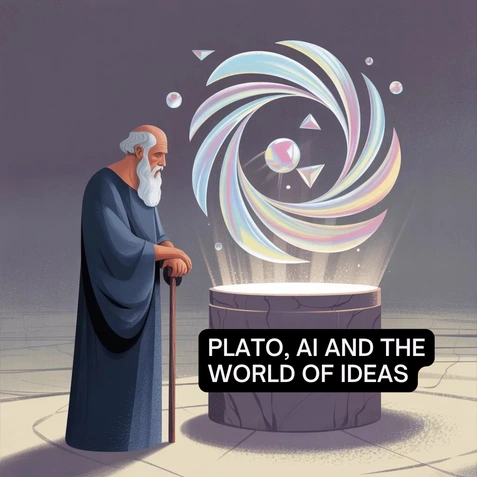
This article explores the tension between Plato’s eternal, immutable Forms and the radically ephemeral nature of digital “ideas” generated by artificial intelligence. While Platonic Ideas inhabit a timeless metaphysical realm, AI‑generated concepts exist only as transient computational outputs, shaped by cloud infrastructures, temporary instances, and probabilistic models. By contrasting the stability of the Iperuranio with the volatility of digital systems, the article examines how neural networks produce unique, non‑persistent “ideas,” how cloud architectures reinforce impermanence, and how the digital age challenges traditional notions of truth, knowledge, and being. Ultimately, it argues for a renewed philosophical awareness capable of guiding humanity out of the “digital cave” and toward a deeper understanding of reality in the age of AI.
This article explores how artificial intelligence forces a radical rethinking of epistemology and ontology, transforming not only how knowledge is produced but also how reality itself is represented. Through personal reflections and philosophical analysis, the author argues that AI shifts truth from causal understanding to probabilistic prediction, reducing human experience to computational patterns. The piece warns against algorithmic determinism and calls for a renewed digital humanism—one that restores human judgment, preserves ontological complexity, and ensures that technology remains a tool serving human flourishing rather than redefining it.
The Vienna Manifesto on Digital Humanities is a public appeal to reflect on and act upon current and future technological development, signed by over 1,000 leaders worldwide.
Generative AI is often celebrated for its efficiency, but this article argues that it acts as a "disabling environment" for the human mind. By redefining our cognitive architecture, AI risks outsourcing critical intellectual faculties—such as critical thinking, memory consolidation, and semantic understanding—to algorithmic systems. We explore the crisis of digital humanism in an age where convenience replaces competence, analyzing how the over-reliance on synthetic content threatens our ability to construct meaning and navigate reality independently.
Generation Beta (2025–2040) will be the first cohort born into a world where artificial intelligence is not an accessory but an ambient condition of life. This article explores the opportunities and risks of growing up in a fully AI‑integrated environment, highlighting the urgent need for critical digital education, ethical awareness, and sustainable values. While Betas may become highly skilled users of intelligent technologies, they also face vulnerabilities such as privacy exposure, digital addiction, and passive dependence on opaque systems. At the same time, their strong orientation toward environmental responsibility and social inclusion positions them as potential leaders of a more sustainable and equitable future. The article calls for a renewed educational commitment to ensure that Generation Beta grows not only technologically competent but also conscious, resilient, and capable of shaping a humane digital society.