Digital Sovereignty Is Decided in Data Centers
Where does your data live? About 80% of Europe's digital infrastructure is controlled from outside the continent. Digital sovereignty isn't a slogan — it is decided in the data centers, software stacks, and energy grids that run our daily lives.
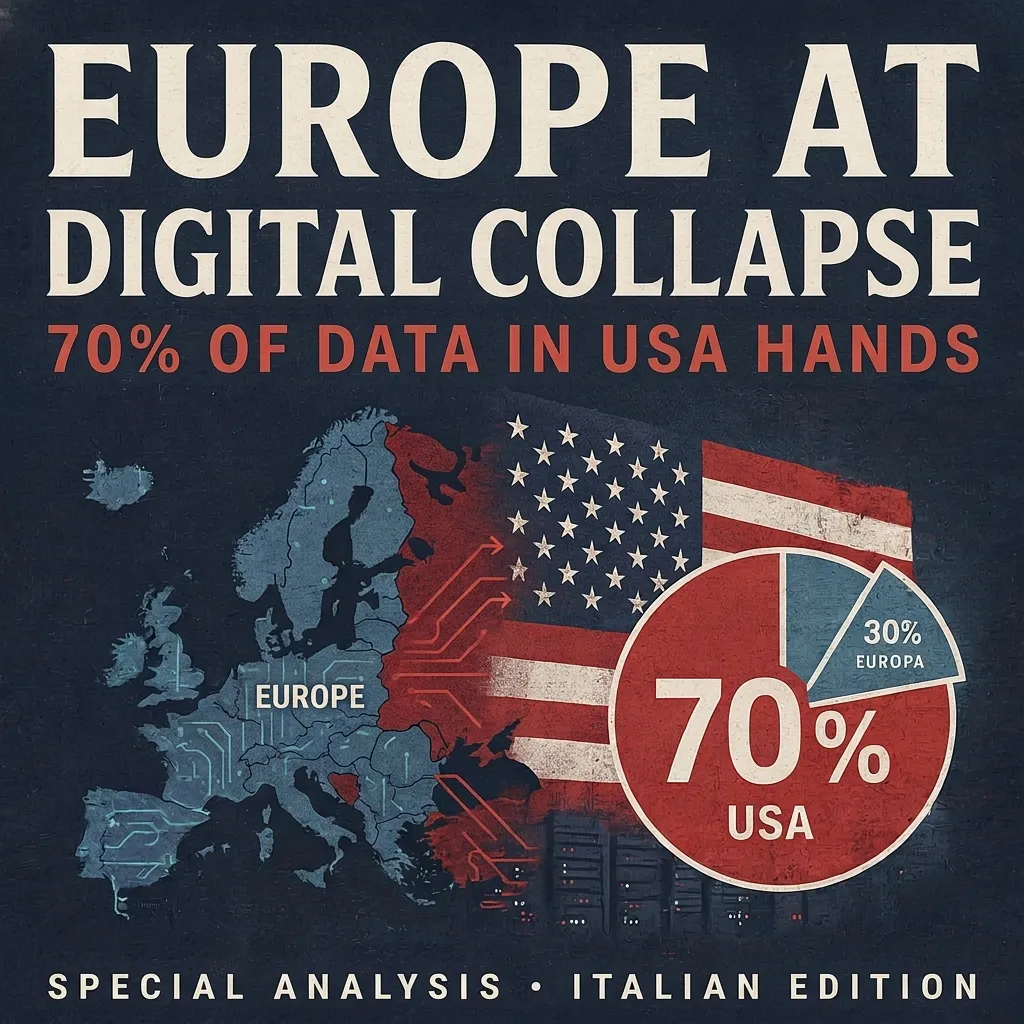
Where Does My Data Really Live? The Geography of Digital Sovereignty
Silicon Valley holds 70% of the European cloud market through Amazon, Microsoft, and Google. Our data ends up under the American CLOUD Act, which allows the US to demand access even when servers physically sit in Europe. Sovereignty isn't just about where you put the server: it's about who owns it, who controls the software, and whose jurisdiction actually counts. In 2025, this isn't a theoretical debate – it's a daily reality for every European citizen who uses a cloud service.
Estonia's lesson: sovereignty through redundancy
Then I think of Estonia. After the cyberattacks of 2007, they created a data embassy – a copy of the state's essential information kept outside its borders to guarantee continuity even in a crisis. They understood that hybrid warfare runs through the digital. A data embassy isn't a contradiction; it's a recognition that true sovereignty means planning for the worst, not pretending borders are digital shields.
France's bet: nuclear power and AI ambitions
France is betting on nuclear power and has announced €109 billion for AI. But a data center running on clean energy still depends on foreign chips and platforms. The infrastructure may be green, but the control chain remains grey. You can power a server with French electrons, but if the operating system, the hypervisor, and the AI models are all American, whose machine is it really?
The software trap: Qwant and Mistral AI
Qwant comes to mind – the French search engine that promised privacy, until the CNIL reminded everyone that it, too, handles data. Sovereignty isn't built with slogans. And what about Mistral AI? Microsoft invested 15 million euros in it, and its models run on Azure. How autonomous can a European company really be if it needs an American platform to function? The answer is uncomfortable: not very, unless we build the stack from the ground up.
Energy: the real bottleneck
The real bottleneck is energy. Behind every AI answer lie processors, cooling, and electricity. Europe wants 75% of businesses to use cloud and AI by 2030, while today we're at 46.7%. What's needed is a strategy: stronger networks, incentives for efficient data centers, and heat that gets reused. Energy isn't just a cost – it decides who gets to build AI. Without a sovereign energy grid for computation, Europe will always be a tenant in someone else's digital building.
A European Strategy: Rebuilding Digital Sovereignty
But sovereignty doesn't mean shutting ourselves off. What we need is a genuine digital single market, where you can switch providers without losing your data, with common standards, portability, and transparent supply chains. The European proposal for a Cloud and AI Development Act points in that direction. It's not about banning American tech; it's about making sure European alternatives can exist and compete on equal terms — a question that belongs to the wider debate on digital humanism and the values behind our digital world.
The cultural challenge: rethinking innovation
In the end, the challenge is cultural. We have to teach that innovation isn't just speed, and that a more automated system is not a freer or more democratic one — the same lesson I explore in Reclaiming the Minute, where attention itself becomes the battleground. When an algorithm decides who gets access to a public service, responsibility remains human. Europe can win back its autonomy, but it must invest in data, energy, and skills. Because the digital future isn't decided only by those who build AI, but by those who control the servers, the energy, and the rules.
Frequently Asked Questions
Who actually controls Europe's cloud data?
Roughly 70% of the European cloud market is held by Amazon, Microsoft, and Google. European data stored on those platforms can fall under the US CLOUD Act, which means sovereignty depends less on server location than on ownership, software control, and jurisdiction.
What is a data embassy?
After the 2007 cyberattacks, Estonia created a data embassy: a copy of essential state information stored abroad to guarantee continuity in a crisis. It shows that sovereignty can mean planning for disruption rather than relying on digital borders.
Does digital sovereignty mean banning American technology?
No. The goal is a genuine European digital single market with common standards, data portability, and transparent supply chains, so European alternatives can exist and compete on equal terms.
Meanwhile, I look at my phone and wonder: whose click is this, really?