Reclaiming the Minute: Attention, Time, and Digital Life
Twenty-five minutes vanished into the phone, a gap between checking the time and looking up to find the coffee cold. In *Reclaiming the Minute*, the author explores how digital life atomizes our attention, turning brief tasks into lost hours.
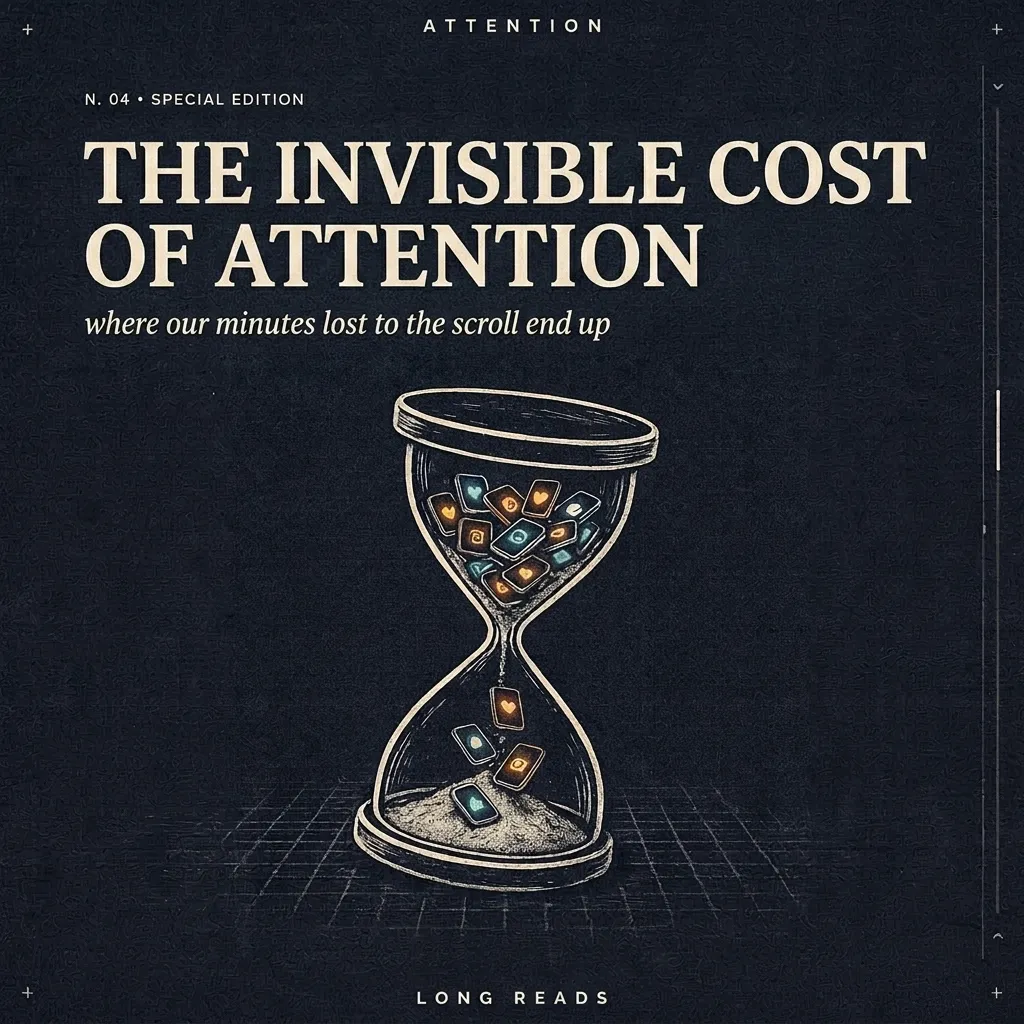
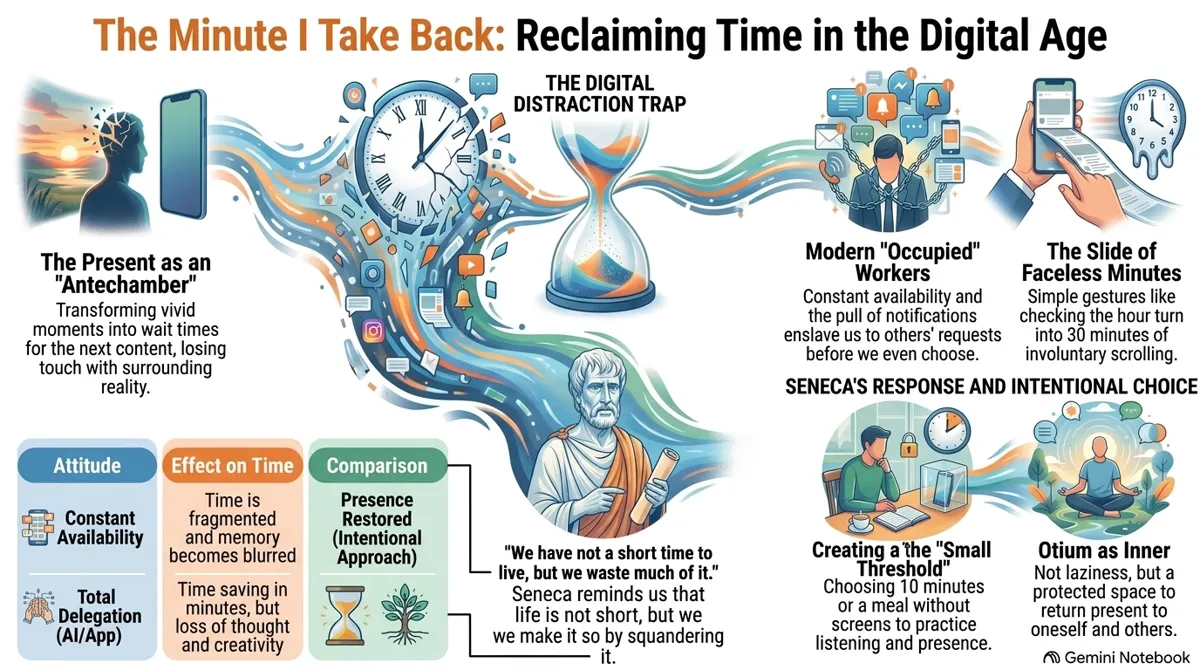
This experience is not unique. The phrase “I have no time” is often spoken while checking a calendar, postponing a call to a missed person, promising to read that book on the weekend. It is not a false statement. Work, children, parents, errands, fatigue,these are real constraints. But beside this truth lies another, smaller and therefore harder to see. In the margins of the day, between one task and another, minutes slip away without a face. Waiting for a bus, during a pause before starting, in bed when sleep is already desired. Sometimes no one snatches them away; they are surrendered willingly, almost unnoticed, to a flow that presents itself as a break but becomes a room in which one stays too long.
Seneca and the Prodigal Life: Reclaiming the Minute
Seneca enters the room. In De brevitate vitae, he writes: “We do not have little time, but we have lost much.” The sentence does not console easily, but that is why it is useful. It does not add an hour to the day; it merely shifts the question: if time is not always as scarce as it seems, where does what we already have go?
Seneca insists that we do not receive a short life,we make it short. We are not poor in time, but prodigal. It is a strong image: a patrimony entrusted to someone who cannot guard it. The author tries to feel it without turning it into a trial. Not because every minute must produce something, nor because rest is waste, but because what is precious deserves to be looked at with care. Even a quarter of an hour.
Seneca speaks of the “occupied,” those absorbed by affairs, ambitions, duties, desires, the expectations of others. The target is not work itself. He describes the moment when one ceases to belong to oneself, because every demand arrives before the capacity to choose. Today, that demand can be in a pocket. It can be a sound, a small red badge, a vibration on the table. It can even be silent, as long as the screen is there.
The Design of Distraction
Digital platforms are not all alike, nor are they merely hostile places. They have allowed connection with distant people, access to useful information, moments of less loneliness. But over time, that presence has become more continuous, more hurried. A message seems to demand an immediate reply, even when it does not. Work can cross the evening through an email or a chat that remains lit at the back of the mind. The habit of availability can make one live every pause with a tense ear.
Many digital environments are built to make the transition from one content to the next as easy as possible. No explicit command is needed; just a sequence of discreet and continuous invitations, promising the next interesting fragment. Attention is a resource with economic value, and permanence becomes a design goal. The author may have accepted conditions and notifications with a click, without truly choosing, one by one, all the interruptions that would enter his day.
Artificial Intelligence and the Next Moment
Recently, artificial intelligence has been added to this flow, with a speed that sometimes arouses curiosity and sometimes leaves one without support. It offers a draft, summarizes a page, suggests a reply, proposes images and ideas in an instant. It can be a concrete help, especially when time is short. But it also makes the future closer and less predictable. What seemed distant yesterday now enters a conversation, a job search, the way a school or office organizes its days.
The most seductive point is always the next one. Another content, another news item, another message. The present becomes a kind of waiting room, the place where one expects something more worthy of attention. Meanwhile, a voice may come from the next room, a dog may rest its muzzle near the door, rain may beat against the glass. The author nods without listening fully.
With AI, that “next” often seems to arrive before being formulated. A platform anticipates a choice, a program orders priorities, a ready-made reply saves the effort of finding words. Sometimes gratitude is felt. At other times, one wonders whether, to gain a few minutes, small acts of thought or creativity are being delegated that one would have liked to traverse oneself. Not because everything must be done slowly, nor because help is a fault, but because hesitation can contain something of one’s own.
Perhaps this is where the anxiety of falling behind grows. There is always a new tool to understand, an update, a skill to add to the list, together with very concrete questions about which jobs will change and which abilities will matter tomorrow. The author has no simple answers. He knows only that uncertainty, when added to haste, tends to occupy more space than necessary. And he does not want to turn every novelty into a race against others or against a more efficient version of himself.
Living in the Present: Reclaiming the Minute
Seneca distrusts a life postponed to a future in which one will finally be free. That future is uncertain, while the present, however brief, is the only point from which one can inhabit existence. Even the past, he says, can be ours if we have the quiet to remember it. Days that are too broken leave a blurred memory, as if one had crossed many images without being truly in any.
The task, then, is not to fill every crevice with activity or to reject every new tool, but to reclaim the ability to choose where one’s attention rests. To look at the coffee while it is still warm. To hear the voice from the next room. To let the thumb rest. To give time a face again.
Frequently Asked Questions
Why do we often feel we have no time, even when we are not busy?
Because time is not only taken by obligations; it is also surrendered in small, unnoticed fragments,while waiting, between tasks, before sleep. Digital platforms and design patterns encourage these small surrenders, making it easy to lose minutes without a clear sense of where they went.
What does Seneca say about the brevity of life, and how does it relate to modern distractions?
Seneca argues that life is not short, but we make it short by wasting it. He warns against being “occupied” by external demands to the point of no longer belonging to oneself. Today, those demands often come through screens, notifications, and the pressure of constant availability.
How do digital platforms and artificial intelligence affect our relationship with time and attention?
Digital platforms are built to encourage smooth transitions between content, making attention a resource to be harvested. Artificial intelligence amplifies this by anticipating choices and offering instant replies, which can save time but also risk replacing the hesitation and creativity that belong to us.
Is the solution to reject technology and slow down completely?
No. The goal is not to fill every minute with activity or to reject new tools. It is to reclaim the ability to choose where attention rests, to inhabit the present rather than treat it as a waiting room, and to give time a face again.
More on this theme: Digitalization and Humanism: The Vienna Manifesto as a Compass, Generative AI and the Crisis of Digital Humanism: The New Cognitive Architecture as a Disabling Environment.
Keep exploring
Deep dives, daily AI commentary in multiple languages, and my curated showcase of lifelong learning.