Open Weights, Closed Power: Sovereignty Is Reversibility
Open weights are not open source: the parameters arrive without the data behind them, and the value drifts to whoever owns the chips. Closed ecosystems can look open, so sovereignty is measured by one word, reversibility: the power to change model, vendor or infrastructure without losing your data or your skills.
When I hear artificial intelligence discussed at conferences or on social media, I often have the impression that we split into opposing fan bases without ever looking under the hood, and I must admit that for a long time I too looked at the open source label as a kind of safe harbour. The idea that someone releases a powerful language model for free, so that we can download it and run it on our own machines instead of knocking again at the servers of some Californian giant, conveys an immediate sense of relief and independence.
Yet the deeper I go into how this technology actually works, the more I realise that our digital sovereignty looks a lot like building a house: owning a single brick, however precious, is nowhere near enough to guarantee a safe roof over your head.
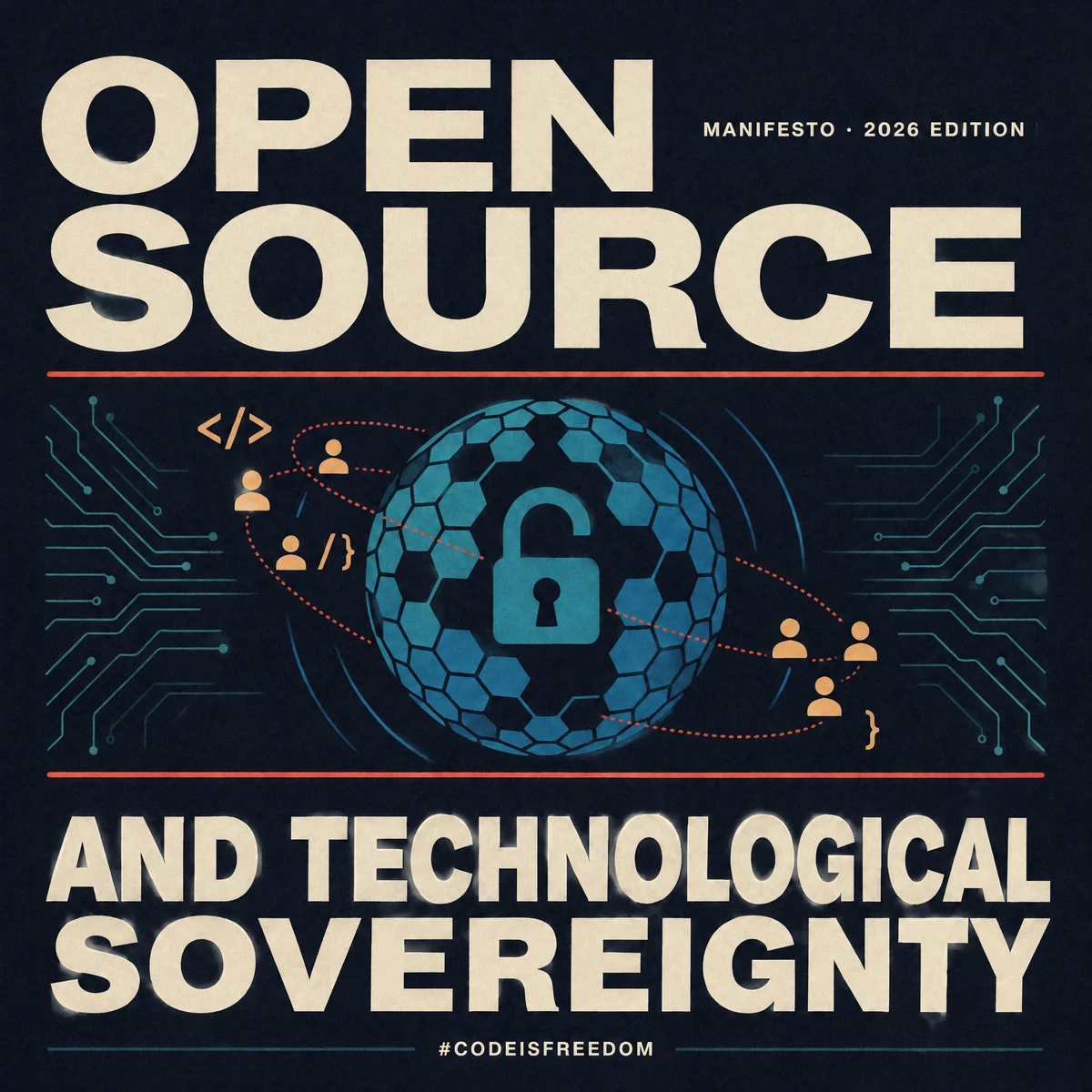
Four freedoms that no longer suffice in artificial intelligence
To understand where the misunderstanding comes from, I like to step back to the world of traditional software, the software that since the 1980s has built the invisible backbone our whole connected life runs on. When Richard Stallman launched the GNU Project in 1983 and formulated the famous four freedoms of free software, and when the Open Source Initiative was born in 1998 while Linux was preparing to conquer servers and supercomputers around the world, the rules of the game were transparent and verifiable. With access to the source code you could read it, fix its bugs alongside thousands of other developers, adapt it to your needs and, above all, avoid being trapped in the hands of a single vendor. That is how the silent pillars of the internet were born, from web servers such as Apache and Nginx to the databases we use every day without even noticing.
Open weights are not open source
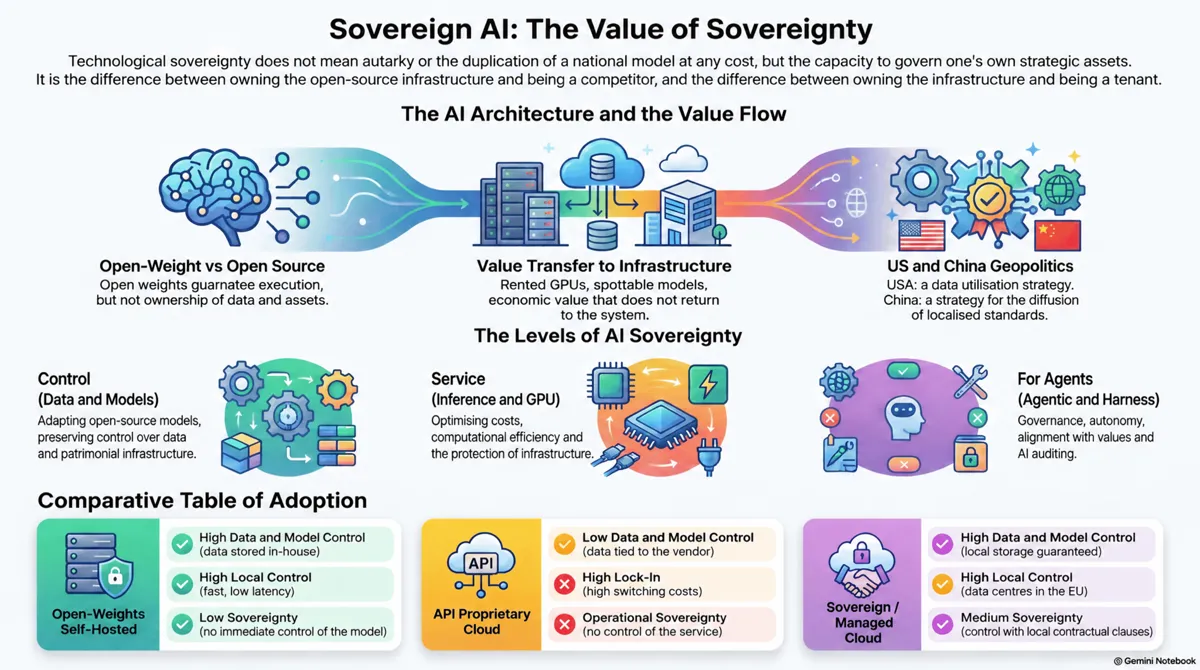
With artificial intelligence I discovered at my own expense that this linear mechanism has cracked, because a modern model is not made of code alone: it is the outcome of training data, optimisation procedures and colossal computing infrastructures. What we enthusiastically call open models today are in most cases open-weight models, systems whose weights are handed to us already trained, a sort of ready-made brain, or, if you prefer, the pre-assembled engine of a car. Being able to download weights such as those of Llama or Mistral is certainly a huge step forward, because it lets us study how the model behaves, adapt it with further training and run it without depending entirely on the company that created it. But having the weights alone, without knowing the data and the code that generated them, is a bit like finding a ready-made cake on the table without the recipe; and even if you tried to put recipe and ingredients together, you would soon realise that training or serving these systems at scale still takes a very powerful oven made of GPUs and data centers. It is no coincidence that the Open Source Initiative itself, when it tried in 2024 to define what an open source AI really is, triggered a lively debate precisely on the transparency of training data.
Who really profits from openness
This is where the human and economic side of the story comes in, the side that usually stays hidden behind slogans about ethics or safety. Consider the parable of OpenAI, founded in 2015 as a non-profit with the promise of sharing research to prevent private monopolies on intelligence, and then gradually transformed until GPT-4 was closed in 2023, between security concerns and training costs out of scale. On one hand I understand the real worries of those who fear dangerous uses, or of those investing enormous capital; on the other, I find Yann LeCun's critique very lucid when he recalls that the safety of a closed system nobody can inspect remains a promise on trust, while the price of lock-in and of the centralisation of power falls entirely on the shoulders of those who use those systems.
The truth, if we look without naivety at what the big global players are doing, is that openness has become an extraordinarily refined industrial and geopolitical lever, one that shifts economic value instead of destroying it. Meta distributed Llama's weights openly, not out of pure philanthropy but following the old Android lesson: make free the component on which competitors build their revenue, so as to consolidate your own standard and move the profit to platforms, services and advertising. On the other side of the world, China played a similar card with initiatives such as DeepSeek and Alibaba's Qwen family, showing that it can reach top-level performance at competitive costs and using open models to build technological soft power and anchor global developers to its ecosystems. And then there is perhaps the most illuminating example of all, NVIDIA with its Nemotron family: the model is released free of charge under permissive licences precisely because the real business is selling the silicon, the GPUs and the CUDA software ecosystem needed to run it at its best. As a bitter but realistic joke puts it, the model is free, and the engine that makes it work is theirs.
What digital sovereignty means for us
If the openness of the model alone ends up transferring economic value to those who own the chips, to the big cloud services such as AWS, Google Cloud or Azure, and to the execution tools, then what does digital sovereignty really mean for us Europeans and Italians, without falling into the illusion of self-sufficiency or into sterile rhetoric?
First of all it means making peace with the idea that sovereignty is not autarky: nobody expects Italy or Europe to produce every single bolt or microchip of the global supply chain on their own. In the same way, I have understood that sovereignty cannot be reduced to keeping data locked on a national server if the software processing it is a black box that cannot be inspected or replaced, because that would be decorative sovereignty only; nor is it enough to stick a flag, or a national name, on a language model to feel safe. Sovereignty is played out on three concrete levels, building, serving and acting, and it is especially on the last two, on the costs and infrastructures of inference and on the control of the agents that reach into our documents and our daily decisions, that we risk losing autonomy without even noticing. Recent news has already shown how fragile it is to rely, without a safety net, on decisions taken elsewhere: the European restrictions Meta imposed on some multimodal Llama 3.2 models in 2024, the temporary US blocks on Anthropic in 2026, and the Chinese export control proposals in October 2026.
The word that matters: reversibility
At the end of this journey, the concept that stays with me like a human and concrete compass, before a technical one, is a simple yet powerful word: reversibility. Our technological freedom is not measured by counting how many models we have trained or how many billions we spent on a single cluster, but by checking whether a company, a hospital or a public administration can change model, vendor or infrastructure tomorrow without losing their data, their skills, their operational memory, and without paying an unsustainable price. Not being prisoners of a choice made yesterday is what turns open source from a passing fashion into real autonomy.
Something is moving, in Europe and in Italy
Looking at what is happening around us, I cannot be pessimistic: something concrete has started moving in our part of the world too. In June 2026 the European Commission finally put on the table a technological sovereignty package that includes an open source strategy worth about two billion euros over seven years, while the EUROPA consortium, led by the Italian company Domyn, won the challenge of building an open multilingual model for the 24 languages of the Union on our EuroHPC infrastructures, flanked by the creation of the Sovereign AI Foundation under the wing of the Eclipse Foundation. In Italy too, where our real strength is not imitating American hyperscalers but protecting and enhancing an extraordinary heritage of industrial and engineering knowledge, important pieces are taking shape: the Minerva models developed by Sapienza NLP on CINECA's Leonardo supercomputer, Engineering's IS-IA sovereign architecture, the INPS AI Welfare project and the AI factory in Bologna.
The challenge: keeping the pieces together
The real challenge now lies in our ability to hold these pieces together, avoiding dispersion into a thousand mutually incompatible streams. Because open source, like a well-designed house, finally gives us the power to choose who we want to be in the age of artificial intelligence: simple tenants renting space on somebody else's platforms, or conscious builders of an ecosystem where technology, labour and skills truly stay in our hands.
For context: this argument continues two earlier pieces on this blog, Digital Sovereignty Is Decided in Data Centers and The Dark Side of the Cloud: Data Centers Out of Control.
Frequently Asked Questions
What is the real level of openness of a model, and what does its licence allow?
A distinction is needed between a genuinely open source system, with access to the code, the components and information about the training data, and an open-weight model, which releases only the learned parameters. The open-weight label does not guarantee the absence of contractual restrictions: terms of use can vary even between versions of the same model family, limiting commercial use and redistribution or imposing obligations on adopters.
Are our data and our working memory still portable and under control?
Sovereignty is lost when data has to leave a controllable perimeter to feed remote services subject to tracking terms or foreign jurisdictions. Before choosing a platform, make sure you can export data, applications and information assets without losing them, or starting from scratch, should you change vendor.
Can we change computing infrastructure and predict inference costs?
Even an open model can create new dependencies if it stays bound to a single proprietary API, a single cloud provider or a hardware and software stack with high replacement costs. It is decisive to know which GPUs and runtimes the system runs on, how easily it can migrate elsewhere, and whether inference costs are transparent rather than exposed to unilateral price changes.
Do we control agents, authorisations and integration protocols?
When AI tools act autonomously, reading documents, querying databases or calling APIs, checking the model alone is no longer enough. You must verify that memory, orchestration, access permissions and protocols such as MCP adopt interoperable and verifiable architectures, so that replacing the platform does not force a rewrite of the whole system.
Do we have the skills and the financial sustainability to replace the vendor?
Being able to download a model is of little use without the in-house expertise to adapt it, integrate it, evaluate its performance and maintain it over time. Because access to models and services can change suddenly through commercial decisions, blockades or geopolitical restrictions, the real test of operational continuity is being able to change course without prohibitive migration costs.
Using this grid before signing a contract or starting a project turns a technological choice from a potential permanent constraint into a governable interdependence, verifiable in its costs, architectures and contractual clauses.
The reflections in this article come from reading the research paper "Open Source, the Power to Choose" by Rivista.AI, Technological Sovereignty series, October 2026, produced with TechVisory from the reflections of Franco Bernabè. The full paper is available here.