Why Prompt Engineering Is Dead and What's Next
Prompt engineering is dead: hand-crafted commands are giving way to context, harness, and loop engineering, where we design the conditions under which AI acts instead of micromanaging every sentence. Here is what is emerging in its place, in four phases you can experiment with today.
Let me walk you through the four phases of this evolution using an example we all love: making a chocolate cake.
Phase 1: Prompt Engineering , The Art of the Perfect Sentence
Imagine a robot chef who has read every cookbook ever written but has no clue what's in your pantry. You type: "Act like a pastry chef and give me a super moist chocolate cake recipe using very little sugar." The machine, drawing from its frozen memory, spits out a beautiful, perfectly formatted recipe , pure theory. It works, it's magical, but when you actually go to the kitchen, the recipe calls for buffalo milk and all you have is half a bottle of oat milk that expired two days ago. That limit naturally led to the next phase.
Phase 2: Context Engineering , Feeding the AI Reality
Instead of asking the machine to guess, we start feeding it files, documents, and real-time data. I attach a text file listing every ingredient in my fridge, the expiration dates, even a note that my old oven burns everything on the right side. I tell the AI: "Read my fridge inventory and adapt the cake recipe to these exact ingredients, considering my uneven temperatures." Now the machine isn't daydreaming , it's seeing my oat milk, calculating substitute chemistry, and giving me a recipe I can actually follow without a desperate trip to the store. Still, I have to get up, mix the batter, and turn on the oven myself.
Phase 3: Harness Engineering , Strapping Tools to the Robot
I started wondering why I should do the manual labor when I had a supercomputer. So we began strapping external tools , web browsers, calculators, code terminals, smart appliance APIs , directly onto the AI. For the cake, I connect the AI to my smart oven and the local supermarket app, then give a high-level command: "Make sure the cake gets baked following the recipe you adapted." The AI sees it's missing baking powder, opens the supermarket app, orders it, waits for delivery, preheats my oven to exactly 160°C to compensate for the earlier defect, and sets a timer. The harness handles the messy real world so the AI doesn't lose track.
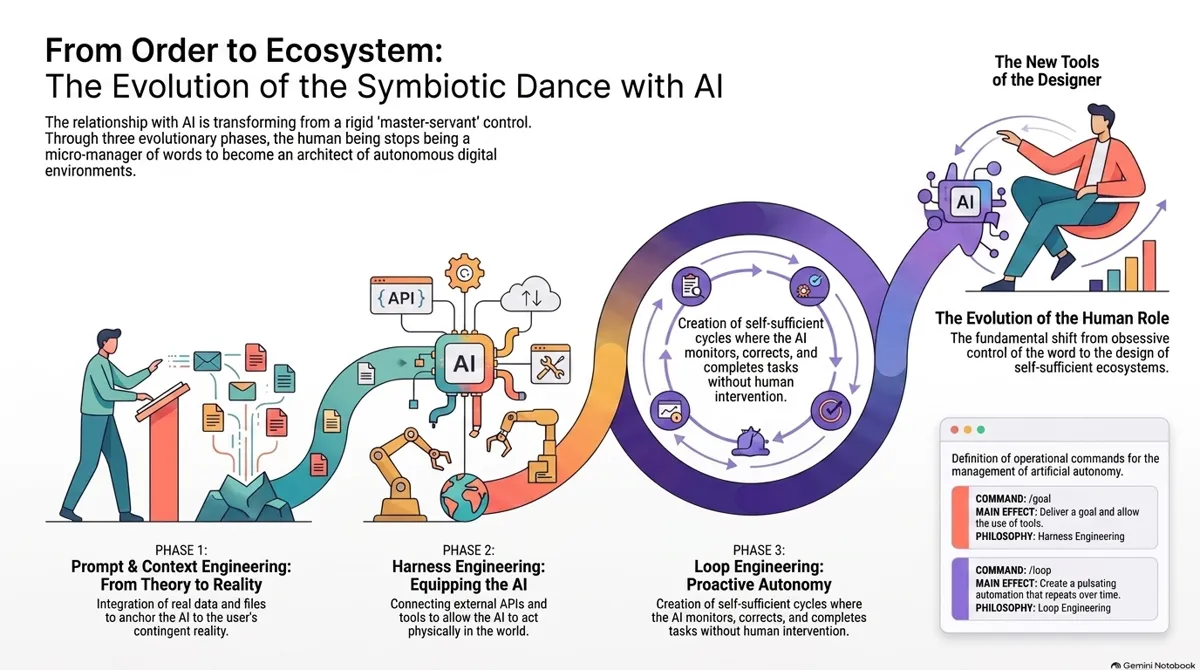
Phase 4: Loop Engineering , The Proactive Agent
But even with a fully tooled AI, I still had to walk into the kitchen and say "Now bake the cake," initiating every single cycle. The final frontier is loop engineering. This turns the AI from a purely reactive tool into a proactive agent. We build an external scaffold that lets the AI give itself instructions, monitor its own results, and self-correct without my involvement. Imagine waking up on a Sunday morning and finding a fresh chocolate cake on the counter. Why? Because the AI, running a continuous background loop, noticed it was Sunday, recalled my weekend sweet tooth, checked the pantry via sensors, saw we were low on flour, ordered it Friday night, prepared the batter Saturday, noticed via camera that the center was slightly sunken, researched why oat milk causes that issue, corrected the recipe internally, and baked a perfect cake just in time for breakfast. That's the essence of an autonomous loop , terrifying and wonderful.
How to Experiment with These Phases Today
Now you can experiment with commands like /goal and /loop. /goal activates harness engineering: you give a destination and let the AI use all tools to get there once, like fixing a Python script until all tests pass. /loop activates loop engineering: a recurring digital heartbeat that monitors conditions and acts autonomously over time, like checking a competitor's site every 30 minutes until "Available Now" appears. Your role has shifted from micro-managing every word to architecting environments, designing cycles, and becoming a philosopher of automation. We're learning to loosen the leash, trust the harnesses we built, and let our artificial partners take a deep, independent breath.
Frequently Asked Questions
For context: the shift from prompts to context echoes what I described in why GEO is replacing traditional SEO and in the new cognitive architecture: as machines change, our interface with them changes too.
What is the difference between prompt engineering and context engineering?
Prompt engineering focuses on crafting a single perfect instruction to the AI. Context engineering goes further by feeding the AI external files, real-time data, and situational details so the output is tailored to your actual environment , like your fridge contents or oven quirks.
How does harness engineering make an AI more useful?
Harness engineering connects the AI to external tools like web browsers, calculators, or smart appliance APIs. This allows the AI to take actions in the real world , ordering ingredients, adjusting oven settings, running scripts , without you having to manually execute each step.
What is loop engineering and why is it called the final frontier?
Loop engineering gives the AI a recurring autonomous cycle: it can set its own goals, monitor outcomes, and self-correct without human prompting. It's called the final frontier because it transforms the AI from a reactive tool into a proactive agent that can act independently over time.
Can I try loop engineering right now with my AI?
Yes, if your AI platform supports commands like /loop, you can set up recurring tasks , for example, checking a website every 30 minutes until a condition is met. Start with a simple goal and watch the AI self-correct before you even notice a problem.
Keep exploring
Deep dives, daily AI commentary in multiple languages, and my curated showcase of lifelong learning.