When Intelligence Becomes Common, Judgment Becomes Rare
When intelligence becomes common, judgment becomes rare: once any AI can process information, the scarce skill is choosing what deserves attention and refusing to mistake noise for signal. This is what the infosphere demands of the next generation.
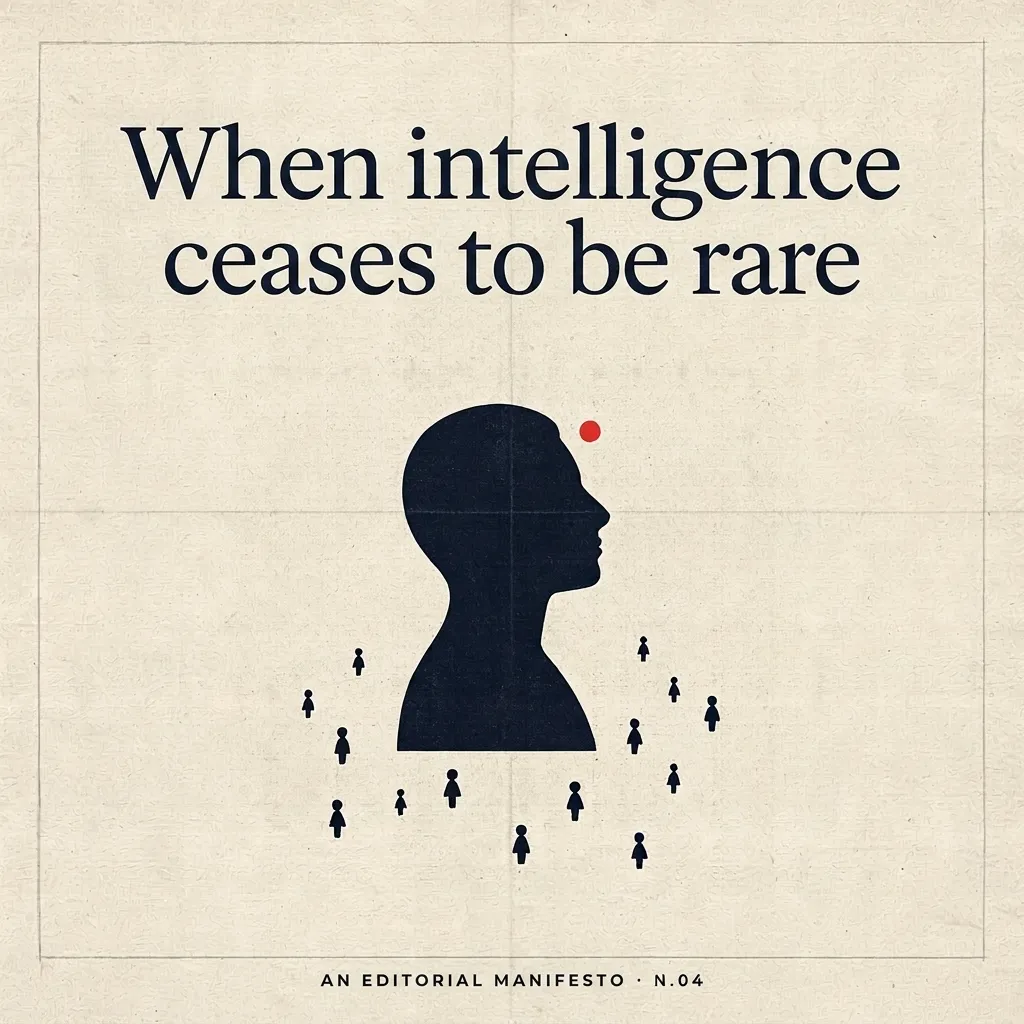
When Intelligence Becomes Common: The Architecture of Scarcity
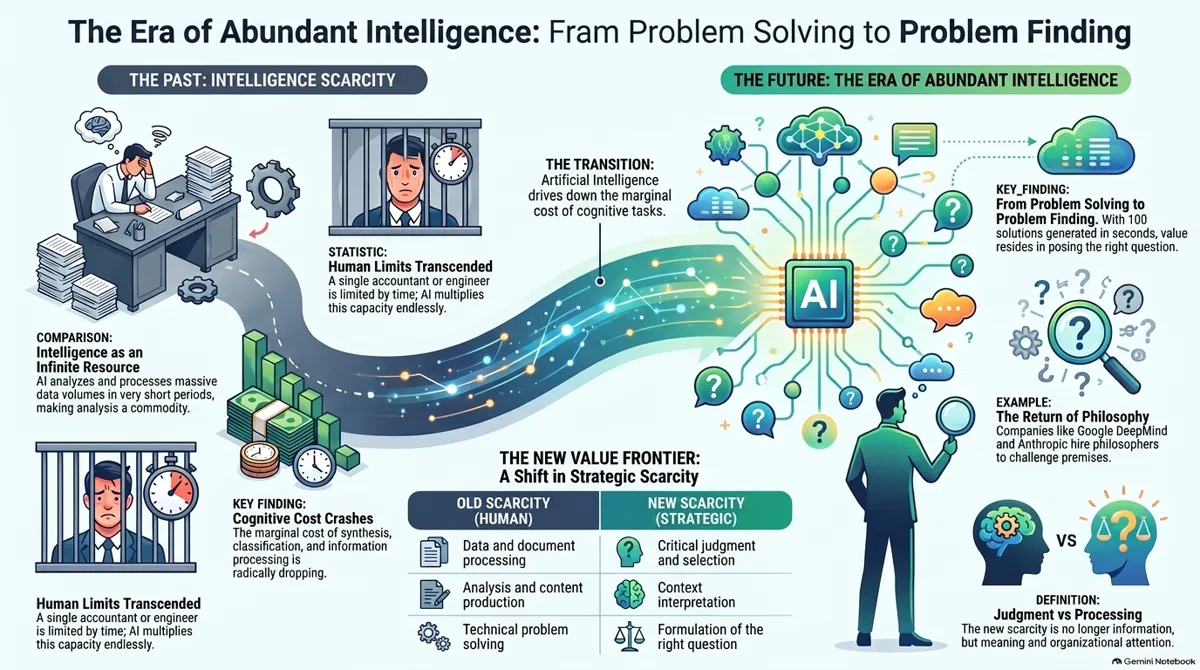
Artificial intelligence has accelerated this shift in a way that feels almost architectural. For decades, companies had to manage a genuinely scarce resource: available intelligence. The concrete kind, the capacity to read information, understand it, compare it, turn it into analysis, and use it to decide. People are finite. Time is finite. An account manager can truly know only a limited number of clients. An engineer can read only so many documents. A manager can pay attention to only a small fraction of what happens inside an organization.
AI changes that premise. It can analyze, synthesize, classify, and process enormous volumes of information in seconds. That kind of intelligence becomes a resource that can be multiplied, distributed, made abundant. Not free, not infallible, not human. But radically cheaper. The marginal cost of many cognitive activities is collapsing.
From problem solving to problem finding
So where does value move? To the question. To the ability to understand which problem deserves to be addressed in the first place. To distinguishing a relevant signal from the noise. To interpreting context, weighing consequences that do not live inside the data, and choosing even when no alternative is perfect. We are moving from problem solving to problem finding. I do not say this to diminish problem solving. It remains essential. But when a hundred solutions can be generated in seconds, the rare skill becomes knowing which problem is worth solving.
This is a quiet change, almost invisible, yet deeply structural. It affects the people we bring into teams and the way we organize companies. It is telling that some of the most important AI labs have started hiring philosophers. Google DeepMind has an internal group of them, at least ten. Anthropic gave philosopher Amanda Askell a significant role in defining the constitution that guides Claude, after her time at OpenAI. This is not merely about ethics. Philosophy trains you to question premises, define concepts with precision, and keep reformulating the problem instead of settling for the first answer.
The paradox of abundance
The paradox is central. The more we produce analysis, ideas, scenarios, and content, the more material someone must evaluate. Scarcity moves from elaboration to judgment, from production to selection, from answers to questions, from information to meaning. A company could have thousands of agents analyzing customers, markets, and competitors without pause, and still make mediocre decisions if no one has designed a system that turns that capacity into organizational attention.
What Intelligence Becomes When It Is Common: Lessons for the Next Generation
This is why I try to bring this paradigm shift into universities. Students face a working world that grows harder to decipher. They do not need easy certainties. They need training in attention: to questions, to contexts, to the consequences of choices. The future of work does not ask us to be faster than machines. It asks us to be more aware of what we choose to make possible with them.
Frequently Asked Questions
For context: the shift from intelligence to judgment connects with my essays on why AI acts rather than thinks and on the new cognitive architecture: when machines get smarter, the human muscle to train is judgment.
What does "problem finding" mean in practice?
Problem finding is the skill of identifying which question or challenge is worth addressing before jumping to a solution. In an era where AI can generate dozens of answers in seconds, the rare human ability is to notice the right problem, define it clearly, and decide that it matters.
Why are AI labs like DeepMind and Anthropic hiring philosophers?
Philosophers are trained to question assumptions, define concepts with precision, and keep reformulating a problem instead of settling for the first answer. This is valuable for designing AI systems that align with human values, and for navigating the deep ethical and structural questions that arise when intelligence becomes abundant.
How should universities prepare students for this shift?
Universities should train students in attention, context, and judgment , not just in technical skills. Students need to learn how to formulate good questions, evaluate competing interpretations, and understand the human consequences of choices, because these are the skills that machines cannot replace.
Does this mean problem solving is no longer important?
No. Problem solving remains essential. The point is that when AI can produce many solutions quickly, the bottleneck becomes deciding which problem to solve. Both skills matter, but the balance of value is shifting from execution to discernment.
Keep exploring
Deep dives, daily AI commentary in multiple languages, and my curated showcase of lifelong learning.