The Revolution Within the AI Revolution: Huawei's Rise
The AI revolution now has a revolution within it: after the United States cut Huawei off from American technology, the company rebuilt its own chips, operating system, cloud, and apps. Here is what Huawei's comeback means for AI infrastructure and the new geopolitics of intelligence.
The Revolution Nobody Saw: How Sanctions Forced a Total Rebuild
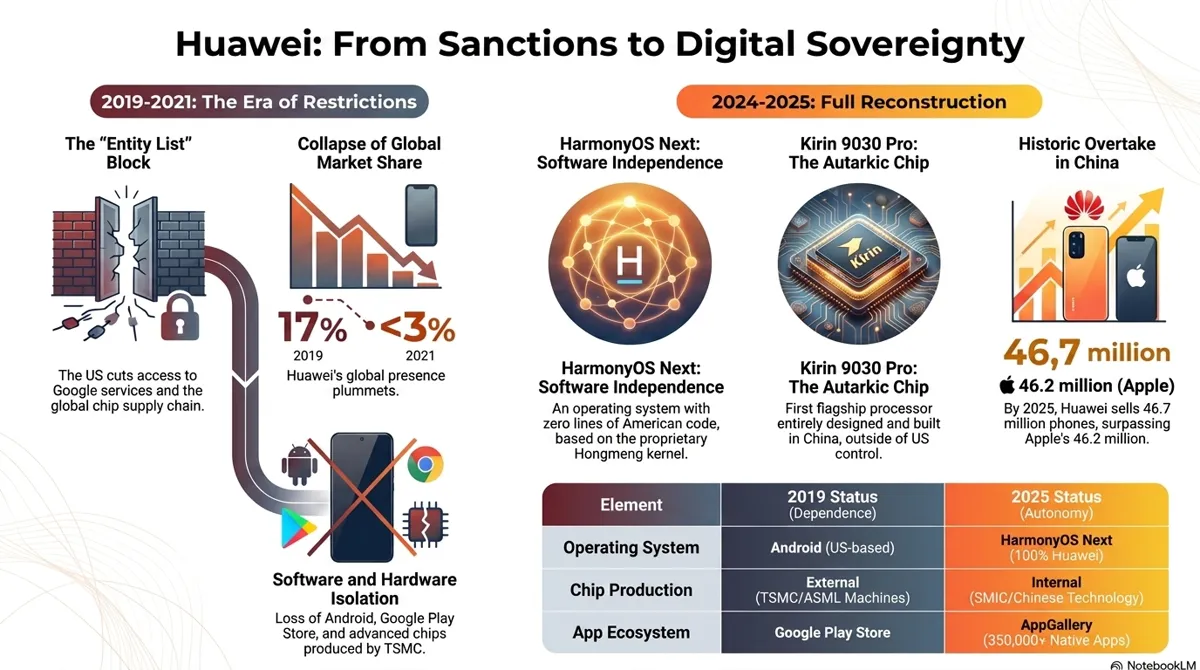
In 2019, Huawei was added to the U.S. Entity List, cutting it off from American semiconductors, Google’s Android operating system, and critical design tools. The company had relied on ARM architecture for its Kirin chips and on Google Mobile Services for its smartphones. Each restriction became a catalyst. Within months, Huawei began developing its own chip architectures, a proprietary operating system called HarmonyOS, and an application ecosystem that now counts hundreds of thousands of native apps. The company also invested heavily in its own cloud infrastructure, Huawei Cloud, which by 2025 ranks among the top five public cloud providers globally by revenue. Each blocked layer became an engineering project. Each setback added urgency, discipline, and a systemic vision.
The new ecosystem: chips, OS, cloud, and apps
What emerged is a genuinely independent stack. The Kirin processors, now fabricated using China’s domestic foundries, power the Mate 60 series and later devices. HarmonyOS, initially a stripped-down Android fork, evolved into a fully sovereign operating system with its own kernel and a growing library of native applications. The AppGallery has attracted developers by offering better revenue sharing and localised services. Huawei Cloud provides everything from basic compute to advanced AI model training environments. In the Chinese market, Huawei’s smartphone sales surpassed Apple’s in 2024, and by early 2025 its market share in China exceeded 40 percent.
What this means for AI infrastructure
The implications for artificial intelligence are profound. AI is not just a software layer; it depends on chips, data centers, cloud platforms, and operating systems. Huawei now controls the entire pipeline: its Ascend AI accelerators compete with Nvidia in the Chinese market, its MindSpore framework provides an alternative to TensorFlow and PyTorch, and its cloud infrastructure supports large model training at scale. If a platform can exist without depending on any external layer, then the very concept of technological dependency enters crisis. Every major government is watching this case closely, because it raises the concrete possibility of redesigning digital sovereignty from the ground up.
As a digital humanist, I read this story as a powerful lesson. Technology is never just a set of tools; it is a form of organisation of power, knowledge, and collective autonomy. This story tells us that even exclusion can generate capacity, that even blockage can produce reconstruction. The true lesson isn’t just that Huawei survived. It’s that the company showed the world a possibility many hadn’t foreseen: you can rebuild an entire technological system without leaning on the foundations of the dominant competitor, and you can arrive at global-scale competition. This changes the question that every government, every industry, and every community must now ask: which layers of my infrastructure still depend on others, and how much would it cost me to rebuild them?
The New Geopolitics of the AI Revolution
If one company managed this, then the future of AI will be written by those who own the infrastructure to run it,and that infrastructure can now be built anywhere, even in isolation. The fragmentation of the global tech economy is no longer a theoretical risk. It is already happening. Huawei has proved that a complete, sovereign stack is technically and commercially viable. The rest of the world must decide whether to embrace that model, compete with it, or attempt to regulate it. I feel both awe at the resilience and concern at the fragmentation. But one thing is clear: the revolution within the AI revolution is not about better algorithms. It is about who controls the chips, the cloud, the operating systems,the entire pipeline. And when that pipeline can be rebuilt from scratch after being shut out of the world’s best tools, the meaning of innovation itself shifts.
Frequently Asked Questions
For context: Huawei's comeback changes the map I drew in digital sovereignty and data centers and in the silent revolution of GEO: control of the stack is the new currency of the AI era.
How did Huawei survive US sanctions?
Huawei responded to sanctions by investing in domestic alternatives for every critical technology: it developed its own system-on-chip designs, created HarmonyOS as a replacement for Android, built its own application ecosystem, and expanded Huawei Cloud into a full-stack infrastructure provider.
Is Huawei’s technology fully independent from the United States?
Yes, for the consumer market in China, Huawei has achieved a technology stack that does not rely on American components, software, or cloud services. This includes processors, operating system, app store, and cloud platform.
What does Huawei’s self-sufficiency mean for the global AI industry?
It demonstrates that a complete AI infrastructure,including chips, training frameworks, and cloud computing,can be built without access to leading Western technology. This reshapes global tech competition and forces other nations to reconsider their own digital sovereignty strategies.
Keep exploring
Deep dives, daily AI commentary in multiple languages, and my curated showcase of lifelong learning.