The Illusion of Free AI and the Coming Digital Caste System
The illusion of free AI lasted barely twenty-four months: what looked like a gift to humanity was a calculated tactic to create dependency. The coming digital caste system will divide those who can pay from those who pay with attention.
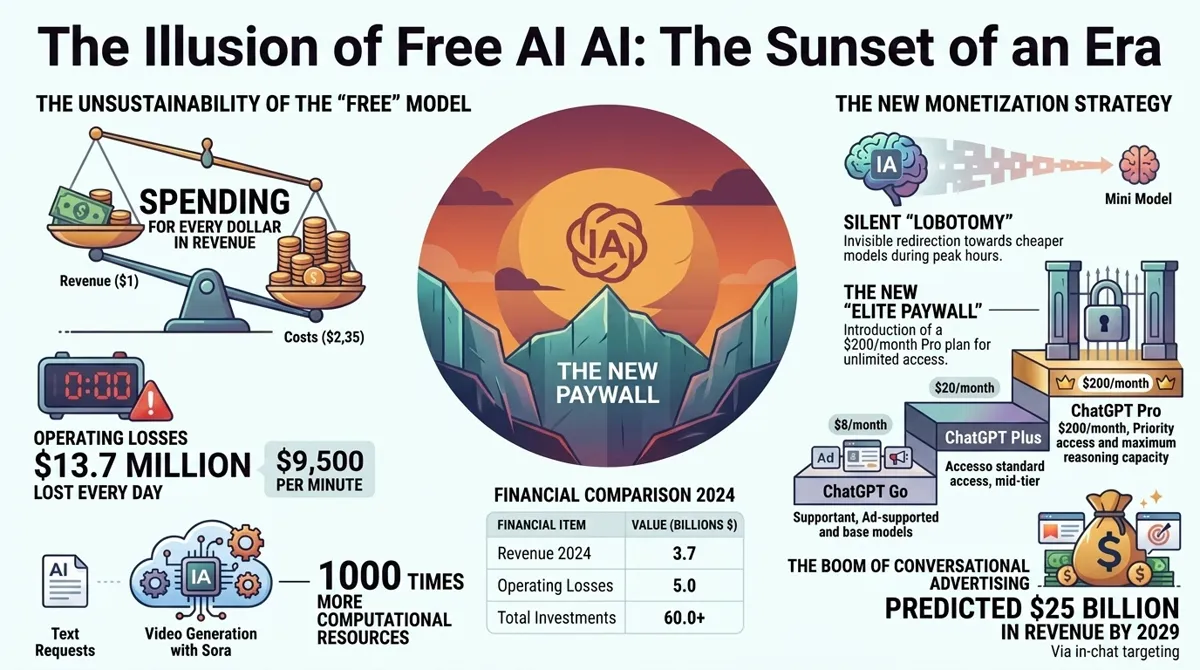
The financial reality is sobering. In 2024, OpenAI reported losses of five billion dollars against revenues of 3.7 billion, burning through 13.7 million dollars every single day. The free tier was never a donation; it was a loss leader, heavily subsidised by venture capital to build user habits. As with social media before it, the strategy was to offer extraordinary technology until users could no longer imagine life without it. Now, with an impending trillion-dollar IPO, the pressure to monetise has become relentless.
The Free AI Illusion Fades: The Fallback Mechanism
Users may have noticed their virtual assistants becoming less capable. This is not imagination. Under the weight of 800 million active users, a mechanism called fallback silently reroutes conversations during peak hours to smaller, cheaper models. This cuts costs from several cents to fractions of a cent, but it also causes loss of context, trivial responses, and subtle errors.
The Coming Caste System: Elite Paywalls
What we are witnessing is a quiet stratification of access: the frontier intelligence, the reasoning that is truly reliable, is being locked behind elite paywalls. The new ChatGPT Pro plan costs two hundred dollars per month. The old twenty-dollar Plus plan is increasingly neglected. Access to intelligence is becoming a caste system.
When companies try to force paid adoption, the results can be disastrous. Microsoft invested billions to integrate Copilot into Office, charging professionals 360 dollars per year. Only 3.3 percent of users accepted. Satisfaction plummeted to a Net Promoter Score of minus 24.1, and Microsoft legally downgraded Copilot to a tool for “entertainment only,” used at the user’s own risk.
The Advertising Trap: When AI Becomes a Display Window
If subscriptions fail, the backup plan is advertising. ChatGPT is about to become a display window. The new “Go” plan at eight dollars and the free tier will serve ads. This is deeply troubling because people confide in conversational AI in ways they never would with social media: medical worries, relationship crises, anxieties at three in the morning. An AI filled with advertisements ceases to be an ally and becomes an opaque intermediary, torn between the user’s truth and the advertiser’s interest.
The Human Cost: Safety Sidelined
In this transformation from non-profit to profit-driven extractor, collateral victims include those who were meant to protect us. Key figures like Ilya Sutskever and Jan Leike left OpenAI, denouncing that safety processes and superalignment had been sidelined in favour of flashy products and commercial deadlines.
We have entered the adulthood of AI. We must abandon both the childish illusion that everything should be free and the fear of being left behind. The real question is no longer why AI costs money, but who will hold the keys to our collective knowledge, under what rules, and with what vision of humanity. The answer will depend on whether we can build balanced freemium models, decentralised open-source communities, or public regulation that guarantees equitable access. It is not merely a technological challenge; it is a deeply philosophical one.
Frequently Asked Questions
For context: this is where the story of free AI ends, a sequel to my pieces on ChatGPT advertising and the real AI disruption of price: when intelligence becomes a tier, society splits.
Why did free AI end so quickly?
The free tier was a loss leader subsidised by venture capital to build user habits. As costs rose and IPO pressure mounted, companies moved to monetise through subscriptions and advertising, ending the era of free frontier intelligence.
How does the fallback mechanism affect users?
During peak hours, conversations are silently routed to smaller, cheaper models. This reduces costs but causes loss of context, trivial responses, and subtle errors, making the AI seem less capable.
Will ChatGPT show advertisements?
Yes, the new “Go” plan at eight dollars and the free tier will serve ads. This raises privacy concerns because users share sensitive personal information with conversational AI.
Why did key safety researchers leave OpenAI?
Ilya Sutskever and Jan Leike left, stating that safety processes and superalignment were sidelined in favour of flashy products and commercial deadlines.
Keep exploring
Deep dives, daily AI commentary in multiple languages, and my curated showcase of lifelong learning.