The Real AI Disruption Isn't Intelligence. It's the Price
The real disruption of AI isn't intelligence: it is the price. American startups are turning to Chinese models like DeepSeek and Kimi because they cost a fraction of Western rivals, and when the gap is this wide, geopolitics becomes background noise.
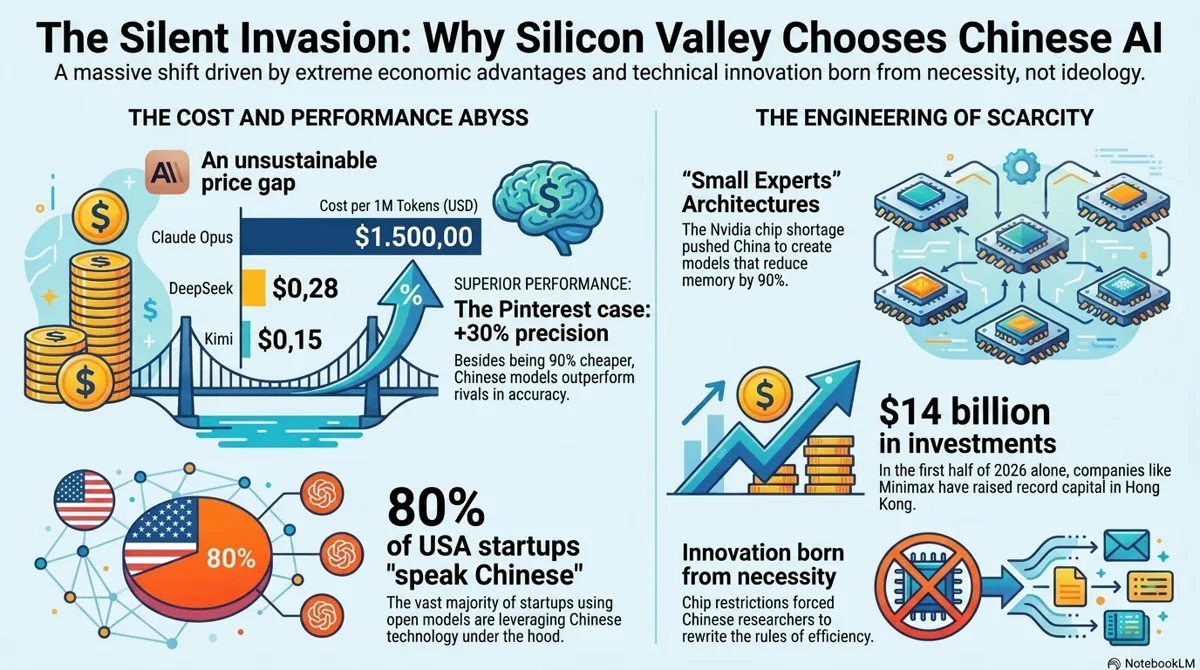
Take DeepSeek: about $0.28 per million tokens. Kimi goes even lower, at $0.15. Now look at Claude Opus, which can charge $1,500 for the same work. That’s not a small discount; it’s an abyss. Imagine choosing between a thousand-euro Michelin dinner and a three-euro perfect sandwich. When you’re feeding an army of algorithms, the choice isn’t really a choice , it’s an obligation. And it works. Pinterest tested Chinese models and found they cost 90% less while being 30% more accurate. When a company sees numbers like that, the conversation shifts.
The Real Disruption Is Arithmetic, Not Intelligence
An estimated 80% of American startups using open models are already “speaking Chinese” under the hood. The market has already decided who won this hand, even as we wonder whether AI is a bubble. In Hong Kong, the gold rush is palpable. Companies like Minimax see investors lining up to lend billions in a single afternoon , $14 billion raised in just the first months of 2026. The wallet has spoken, and it speaks Mandarin.
Disruption at the Margin: How Scarcity Forged a New Engineering
What fascinates me most is how they got there. The United States tried to hobble China by restricting access to powerful Nvidia chips. Instead of complaining, Chinese engineers rewrote the rules. They built architectures using hundreds of small experts working together, cutting memory consumption by 90%. They learned to run giant models on scrap chips. It’s the engineering of scarcity turned into a sharp weapon , a lesson in doing more with less that Silicon Valley had forgotten.
This is not just a cost advantage; it is a fundamentally different approach to AI. While the US and Europe raced to build ever-larger monolithic models, Chinese teams focused on efficiency and accessibility. The result is a stack that makes advanced AI as cheap and ubiquitous as a utility.
What Europe Can Learn , Or Lose
Us Europeans? Here’s where it gets bitter, and I say this with a heavy heart. We are great at studying, reflecting, producing talent , who then take a plane to work elsewhere. We have culture, ethics, but we’re slow. Stuck between endless regulations and a chronic inability to team up. While we write the perfect instruction manual, others are already building the house. The lesson is always the same: it’s not the one who invents the light bulb who wins, but the one who lights everyone’s streets at a bargain price. It happened with the internet, with phones, and it’s happening again. AI today is like water: cheap, accessible, ready to flow everywhere.
The real question, the one I ask myself at night when I close my laptop, isn’t what’s happening in Beijing or San Francisco. It’s whether we, watching from the sidelines, will start building something or remain spectators of a future written by others.
Frequently Asked Questions
For context: the price war is the economic side of the story I told in data centers spinning out of control and in the invisible AI trends of 2026: when compute gets cheaper, the disruption stops being about intelligence and starts being about access.
Why are American startups choosing Chinese AI models over American ones?
The primary reason is cost: Chinese models like DeepSeek and Kimi cost a fraction of their US counterparts , sometimes 90% less , while often matching or outperforming them in accuracy. For startups operating on tight budgets, the choice becomes purely economic.
How did Chinese engineers overcome US export restrictions on advanced chips?
Instead of relying on high-end Nvidia chips, Chinese researchers developed architectures that combine hundreds of smaller expert models, reducing memory consumption by up to 90% and enabling powerful AI to run on far less capable hardware. Scarcity forced innovation.
What does this trend mean for European AI development?
Europe risks becoming a bystander if it continues to prioritise regulation over experimentation and large-scale investment. While the continent produces excellent research and talent, it often fails to commercialise breakthroughs or deploy them at competitive scale, leaving the market to US and Chinese players.
Keep exploring
Deep dives, daily AI commentary in multiple languages, and my curated showcase of lifelong learning.