The Dark Side of the Cloud: Data Centers Out of Control
The dark side of the cloud is the data center: concrete, steel, energy, and water hiding behind a light metaphor. As AI demand grows, these colossi are spinning out of control, and their weight is landing in cities next to us.
A single large data center can consume as much electricity as a medium-sized town. According to the International Energy Agency, data centers already account for about 1–1.5% of global electricity use. With the explosion of generative AI, that demand is set to skyrocket. Every time you save a file online, you are not sending it to heaven; you are activating a complex industrial chain that needs constant power, relentless cooling, and critical infrastructure. The cloud is not light. It is just hidden.
The Heavy Reality of the Cloud
There is a point where technology stops being just innovation and becomes a matter of power. That is when governance enters the picture. Big tech companies have built a clever narrative: making data on energy, water, and environmental impacts public would reveal industrial secrets. Europe has largely accepted this, introducing confidentiality mechanisms that shift control upward. Inspections are centralized at the EU level, while local communities, regions, and municipalities lose their say. Here is the paradox: the people who live next to these infrastructures, who breathe their effects and share their risks, have the least tools to understand them or influence their development.
The Hidden Industrial Chain
As a digital humanist, this fracture feels disturbing. The technology that promised to democratize knowledge and distribute power is silently concentrating it in the hands of a few. When power concentrates, transparency becomes a luxury. And democracy becomes a negotiable option.
A Democratic Deficit in Digital Infrastructure
The most striking example is in Italy, at the gates of Milan, between Binasco and Zibido San Giacomo. There is a two-billion-euro project linked to Bill Gates to build one of the largest data centers in Europe. Its energy needs are monstrous, comparable to the entire city of Bologna. The private developers even asked the state to build a dedicated power plant next to it, paid for by taxpayers. For these colossi to work, they need endless energy. They can never be turned off.
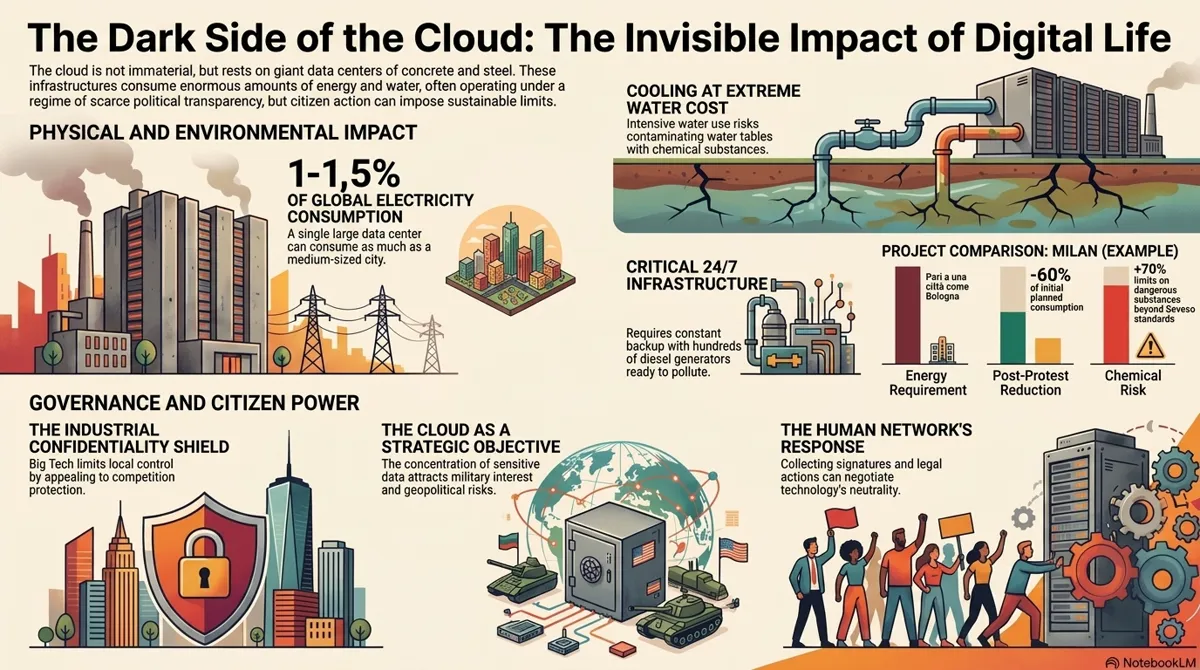
In the Netherlands, authorities are already asking people to get used to blackouts so that machines get priority. If the power goes out in Milan, 150 emergency generators will burn tons of fuel, creating heat islands. Worse, the water needed for cooling is enormous. And the chemical risk is real. In the Milan project, the limits on dangerous substances were 70% higher than those set after the Seveso disaster of 1976. Pollutants like PFAS can end up in the groundwater. And we drink that water. Then there is security. Municipalities are digitalizing everything, from documents to registries, and all this sensitive data ends up in the same servers. This concentration attracts military interest, turning these civilian megastructures into potential strategic targets. Living nearby is not ideal.
The Cloud Comes to Milan: A Colossus Next Door
Water, chemicals, and security
Fortunately, there is resistance. In the Milan and Pavia areas, a citizen committee has formed. Through petitions and constitutional arguments, they managed to force the designers to cut initial energy consumption by 60%. Unity works. Technology is useful, but there is a limit: people’s health. The cloud has a dark side. It is time we all looked at it.
[VIDE1]Frequently Asked Questions
For context: the physical weight of the cloud is the other face of the story I told in digital sovereignty and data centers and in the geopolitics of AI infrastructure: whoever controls the concrete, controls the computation.
Why is the cloud called a cloud if it is physical?
The term "cloud" is a metaphor that deliberately obscures the massive industrial infrastructure behind online services. In reality, cloud computing relies on huge data centers full of servers, cables, and cooling systems that require enormous amounts of energy, water, and land.
How much energy do data centers really consume?
Data centers currently account for about 1–1.5% of global electricity consumption, accoring to the International Energy Agency. A single large facility can use as much power as a mid-sized town, and the demand is rapidly increasing with the growth of AI and cloud services.
What are the main risks for communities near data centers?
Local communities face risks from high energy demand (potentially leading to blackouts), massive water consumption for cooling, chemical pollution including PFAS, and security threats if these facilities become strategic targets. In Italy, a proposed data center near Milan showed limits on dangerous substances far higher than after the Seveso disaster.
Can citizens influence data center projects?
Yes. A citizen committee in the Milan and Pavia area successfully forced a project redesign that reduced energy consumption by 60% through petitions and constitutional arguments. Grassroots resistance can work when communities organize and assert their rights to health and transparency.
Keep exploring
Deep dives, daily AI commentary in multiple languages, and my curated showcase of lifelong learning.