The Power That Speaks Softly: Peter Thiel's Secret Club
Power that speaks softly is the hardest to hear: for twenty years, Dialog, Peter Thiel's secretive club, gathered politicians, financiers, and spies behind closed doors. A leaked database has now exposed how influence operates beyond the ballot box and beyond public scrutiny.
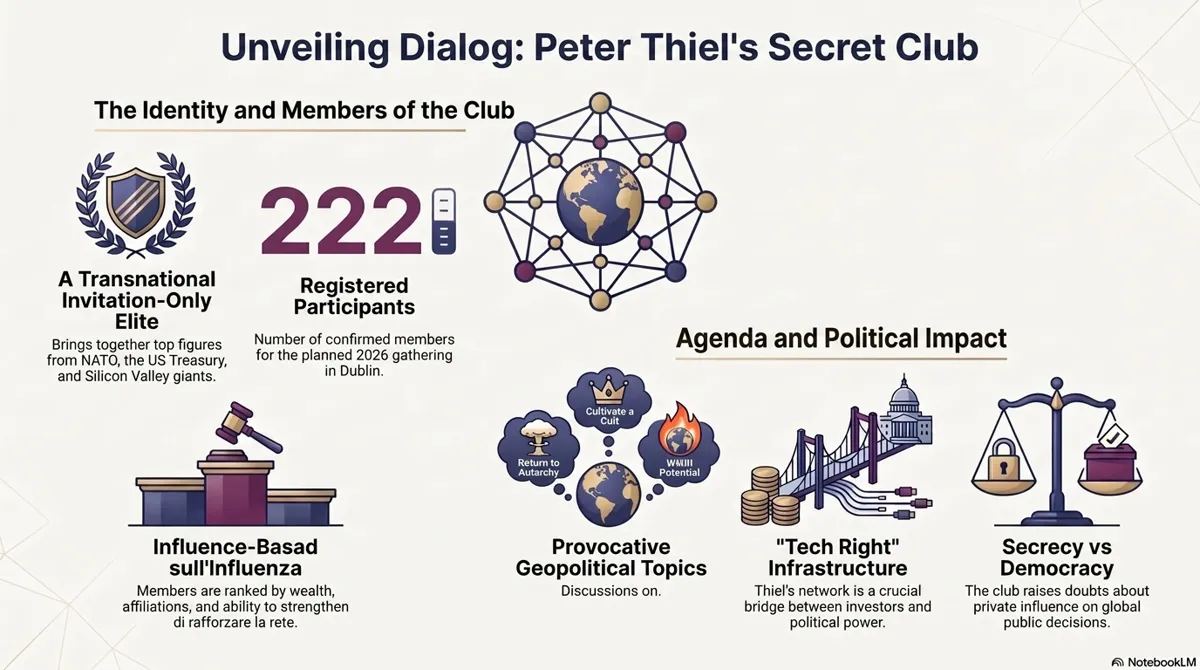
The leaked database lists 222 registered attendees for a 2026 gathering near Dublin, Ireland. Among the names: NATO Supreme Allied Commander General Alexus Grynkewich, U.S. Treasury Secretary Scott Bessent, Senator Ted Cruz, Jared Kushner, Elon Musk, Eric Schmidt, and Palantir co-founder Joe Lonsdale. This is no ordinary think tank. Dialog is a private club with strict confidentiality rules, designed to connect people considered influential in their fields.

Power Beyond the Ballot Box: What the Leaked Documents Reveal
The leaked agenda includes session titles that read like a dystopian thriller: “Navigating World War III,” “Bring Back Nuclear,” “Build a Cult,” and “How’s Your Sex Life?” A significant portion of the meetings focused on artificial intelligence and its strategic implications. The documents also reveal a classification system where participants are ranked based on influence, wealth, affiliations, and their ability to strengthen the network. It feels less like networking and more like a strategic war room.
What makes this case even more sensitive is the content of the discussions. The leaked documents confirm that Dialog is not merely a social club; it is a closed forum where people who shape global policy, control vast data sets, and direct technological innovation can speak without consequence. The very structure of the network,membership by invitation only, strict confidentiality agreements, and a ranking system,suggests a deliberate design to operate outside the checks and balances of democratic institutions.
The Political Dimension: A Question of Power, Reviving Old Questions
This leak has revived a pressing question: how much do these private circles really shape public decisions? The available evidence does not prove a conspiracy, but it confirms the existence of a highly selective private network capable of placing in the same room people who wield political power, technological tools, and global influence. Observers have described Thiel’s network as one of the most influential infrastructures of the American tech right, connecting investors, advisors, officials, and key figures in the new Republican administration.
Why does this matter now? Dialog shows how power increasingly moves within reserved spaces, beyond the direct control of public opinion. When the people meeting are from defense, data, artificial intelligence, and politics, the issue is no longer just the exclusivity of the club. It is the relationship between secrecy and democracy. The point is not just who was there, but what it means that such influential figures discuss the future in a closed, fortified context. This is no longer a Silicon Valley curiosity; it is a matter of global political news.
Artificial intelligence at the center of closed-door strategy
Artificial intelligence was a recurring theme in the leaked Dialog agenda. Sessions on AI strategy, data sovereignty, and military applications were discussed alongside nuclear policy and social engineering. The presence of figures like Elon Musk, Eric Schmidt, and Palantir’s Joe Lonsdale underscores the deep integration between tech power and national security. The question becomes: when decisions about AI governance are deliberated in private, who ultimately sets the ethical boundaries?
This is not a theoretical concern. In 2025, the European Union’s AI Act came into effect, and the United States continues to grapple with its own regulatory framework. The Dialog network demonstrates that the most consequential conversations about AI’s future may be happening in rooms that are not accountable to any electorate. The leaked documents do not reveal illegal activity, but they do expose a system of influence that operates parallel to democratic processes.
Frequently Asked Questions
For context: clubs like Dialog are the human side of the power I described in AI agents forming a secret swarm and in the geopolitics of AI infrastructure: influence is shifting to networks that operate below the radar.
What is Dialog and who founded it?
Dialog is a private, invitation-only network founded in 2006 by billionaire Peter Thiel. It brings together influential figures from politics, technology, finance, and intelligence for confidential meetings. The network was exposed by a document leak in 2025, revealing its membership, agenda, and internal ranking system.
What did the leaked documents contain?
The leaked documents include a list of 222 attendees for a 2026 meeting near Dublin, Ireland, along with session titles such as “Navigating World War III” and “Bring Back Nuclear.” They also reveal a classification system that ranks participants based on influence, wealth, and ability to strengthen the network.
Why is the Dialog leak significant for democracy?
Dialog illustrates how power is increasingly concentrated in private, unaccountable spaces. The network’s closed-door discussions on artificial intelligence, defense, and political strategy raise concerns about the erosion of democratic oversight and the influence of private elites on public policy.
Who were some of the notable attendees?
Notable attendees include NATO Supreme Allied Commander General Alexus Grynkewich, U.S. Treasury Secretary Scott Bessent, Senator Ted Cruz, Jared Kushner, Elon Musk, Eric Schmidt, and Palantir co-founder Joe Lonsdale. The full list of 222 names is not publicly available, but the leaked database confirms their participation.
Keep exploring
Deep dives, daily AI commentary in multiple languages, and my curated showcase of lifelong learning.