From Fire to the Infosphere: The Story of Humanity Told Through Information
We hold more information than any generation before us, and we feel more confused than ever. Read as a history of information, from the voice around the fire to the infosphere, the pattern repeats: every explosion of knowledge opens a season of vertigo, and it ends only when we learn to build new filters.
Ignorance is a void, confusion is an excess. Human history is best read as a history of information: every time knowledge explodes, we go through a season of vertigo, until we learn to build new filters.
We are used to reading human history as a long sequence of empires rising and falling, battles won and lost, mechanical inventions or expanding markets. Yet if we look at our journey more intimately, we discover an invisible thread that holds everything together: the way we produce, keep, exchange and filter information.
Every great turning point in our civilisation has been, first of all, a revolution of knowledge. It has silently redrawn who could know what, how fast and with how much confidence. Following that thread today brings us in front of a paradox many of us feel on our own skin, often with a sense of tiredness and bewilderment: we possess the most immense quantity of information that has ever existed, and yet we inhabit perhaps the greatest state of collective confusion in our history.
To understand this unease without judging ourselves too harshly, we have to take a step back, to the beginning of our journey.
Around the Fire: When Memory Lived in Bodies
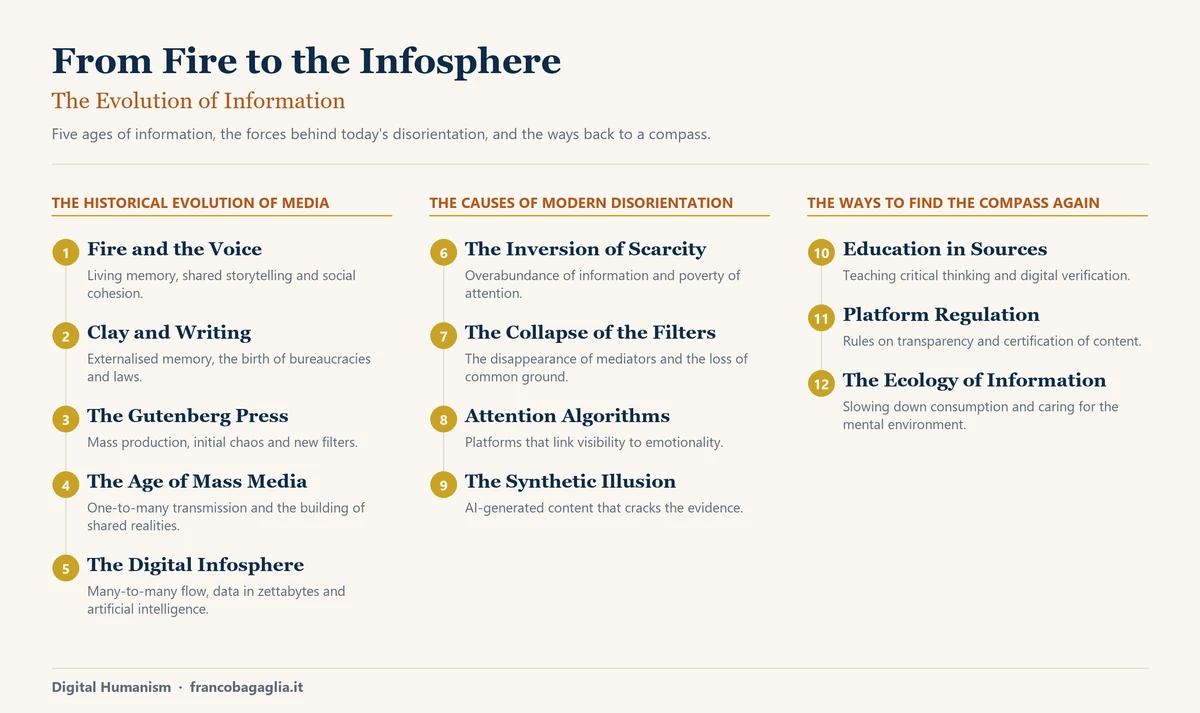
For tens of thousands of years, human words had only one home, the mind, and one vehicle, the voice. When our ancestors sat around the fire, the birth of articulate language performed a first, extraordinary miracle. It was no longer needed only to point at an immediate danger in the bushes; it allowed us to evoke what was not there, to remember the past, to imagine the future. As the anthropologist Robin Dunbar suggests, speech even served us for gossip: weaving stories about others was the most effective way to understand who to trust and to hold the community together. The historian Yuval Noah Harari adds that it was precisely the ability to believe together in myths, spirits and ancestors that allowed us to collaborate in ever larger groups.
In that ancient world, information looked a lot like us: it was fragile, alive, tied to breath. It travelled at the speed of a walking man and died with the voice of the person who kept it. The elders, the singers and the shamans were the living libraries of the tribe, and they used rhythm, rhyme and repetition, as would later happen in the Homeric poems, so that memories would not slip away. Knowledge was scarce, certainly, but it had a reassuring warmth: it was coherent, shared, and it allowed all the inhabitants of the village to recognise themselves inside the same story of the world.
Clay and Ink: Memory Leaves the Body
Around 3300 BC, on the Mesopotamian plain, in the ancient city of Uruk, someone carved some signs on a clay tablet. They were not love verses or prayers to the gods, but simple accounts: sacks of grain, heads of livestock, tributes. Writing was born like this, as a modest administrative tool, and yet it changed human destiny for ever. For the first time, a thought could survive the death of the person who had formulated it. Memory left the body to settle on matter, making possible written laws such as the Code of Hammurabi, bureaucracies, contracts and great empires.
But every conquest carries a shadow with it. Writing drew an invisible border between those who could decipher those signs and those who remained excluded: scribes, priests and officials became the keepers of a silent power. Even then, someone sensed the price of this transformation. In the Phaedrus, Plato has Socrates say that writing would bring "oblivion into souls", because men, trusting external signs, would stop exercising their inner memory, settling for the appearance of wisdom instead of true wisdom. It is the first documented critique of an information technology, and yet it sounds incredibly familiar.
Even when the Phoenician and Greek alphabets made writing more agile, letting legendary places such as the Library of Alexandria flourish, and when in the Middle Ages the copyist monks saved ancient texts by copying them patiently for months, knowledge remained something rare and precious. Information was still scarce, and precisely for that reason it stayed guarded, slow and controllable.
Gutenberg's Press: The Explosion and the Disorientation
Then, around 1450, in a workshop in Mainz, Johannes Gutenberg assembled movable type. Within a few decades, book production moved from the patient rhythm of the hand to the pressing rhythm of the machine, and by the end of the fifteenth century millions of printed copies were already in circulation.
It was the second great information explosion, and it is by looking at that age that we can recognise, with a touch of tenderness, our own bewilderment. Printing, in fact, did not bring order and progress straight away; it brought above all a great chaos. Martin Luther's pamphlets inflamed Europe and plunged it into more than a century of religious wars; manuals such as the Malleus Maleficarum became publishing successes that fed the witch hunts and the burnings; apocalyptic prophecies, false miracles and defamatory libels circulated everywhere: the real fake news of the sixteenth century.
Humanity took almost two centuries to build the antibodies needed to withstand that shock. New institutions were invented, designed to filter, verify and give order to the world: the scientific method and academies such as the Royal Society, peer-reviewed journals, the great Enlightenment encyclopaedias, professional journalism with its ethical rules, public libraries and mass education were all born then.
History thus left us a precious lesson: every time information explodes, we inevitably go through a season of vertigo, until we learn to build new filters to find our bearings.
The Threads of the Ether: A Common Square at the Speed of Light
In the nineteenth century, the telegraph broke for the first time the link between the message and the body that carried it: a piece of news could cross the ocean in minutes rather than weeks. The telephone followed, then radio and finally television.
The age of mass media had begun, built on a one-to-many model, in which a few voices, newspapers, radio networks, television channels, spoke simultaneously to millions of people. We know well how fragile and dangerous that power was in the hands of the twentieth-century totalitarianisms, capable of turning radio into a capillary instrument of propaganda. But in the post-war democracies, that same mechanism generated a precious side effect: it built a shared reality.
Millions of families sat in the evening in front of the same news bulletin and read the same newspapers. Certainly those mediators, editors, reporters and journalists were human, imperfect and sometimes partisan, but they offered a common ground of facts to discuss, even when those facts were interpreted in opposite ways. Meanwhile, in 1948, the mathematician Claude Shannon turned information into a measurable quantity, the bit, planting the invisible seed of the world that was about to arrive.
Inside the Infosphere: When the Web Becomes Our Home
In recent decades, with the arrival of computers, the World Wide Web, search engines, social networks and smartphones, the very structure of communication has been turned upside down. We have moved from the one-to-many story to an incessant buzz of many-to-many, in which the cost of publishing and sharing has fallen almost to zero.
At first it looked like the fulfilment of an ancient dream: all human knowledge within reach, free, open to anyone, embodied in collective wonders such as Wikipedia. But beneath the surface of that gratuity a new economic model was taking shape, in which the real currency of exchange was not money, but our attention.
The philosopher Luciano Floridi found the right words to describe this new condition, making the concept of the infosphere famous: we no longer use technologies as simple tools to put away after use, we inhabit them like the air we breathe. We live onlife, in a dimension where the border between digital existence and physical existence has dissolved. After Copernicus, who took us out of the centre of the universe, Darwin, who took us out of the centre of the animal kingdom, and Freud, who showed us that we are not masters even of our own unconscious, Alan Turing and computer science completed the fourth revolution: they revealed to us that we are no longer the only beings capable of processing information. On this blog I came back to his argument in Luciano Floridi: AI Does Not Think, It Acts, and it remains the clearest compass I know for these questions.
Today we measure the data produced every day in zettabytes, thousands of billions of gigabytes, generating in a few hours more information than humanity produced in entire millennia. And with the arrival of generative artificial intelligence, an ever larger slice of that flow no longer comes from a human mind at all.
Why We Feel So Disoriented Today
So we arrive at the question that often accompanies us in silence, while we scroll the phone screen in the evening: why, having access to everything, do we feel so confused? Why has it become so hard even to agree on the simplest facts?
It is worth making a gentle but clear distinction. The past was not a golden age of lucidity: for centuries most human beings lived in ignorance and superstition. But ignorance and confusion are not the same thing. Ignorance is a void: it is not knowing. Confusion is an excess: it is finding ourselves immersed in a thousand contradictory versions of reality with no compass left to find our bearings. The medieval peasant knew very little, but he inhabited a coherent story; we know a great deal, but we inhabit a thousand stories in conflict with one another.
This sense of vertigo does not depend on an individual weakness of ours, but on a series of deep forces acting together:
- The inversion of scarcity. For millennia the effort was to find information; today the effort is to defend ourselves from it. As early as 1971 the economist Herbert Simon had intuited that a wealth of information inevitably creates a poverty of attention. The precious resource is no longer knowledge, but our mental time, while our instincts remain calibrated to a world in which every piece of news was rare.
- The collapse of the filters. The web has swept away the old mediators. Today an unfounded opinion or a skilfully built lie wears the same graphic clothes as a rigorous scientific study, often gaining far more visibility. The old keepers of knowledge are weakened, but we have not yet built new institutions capable of replacing them.
- An economy that rewards agitation. The algorithms of the platforms are not evil, but they obey a precise goal: to keep us on the screen as long as possible. And they learned early that anger, fear and outrage catch the eye far more than calm and nuance. A study by MIT published in Science in 2018 showed that false news travels faster and further than true news, precisely because it lights up stronger and more immediate emotions.
- The fragmentation of common ground. If once we all watched the same images, today each of us inhabits a tailor-made information flow. Digital communities end up polarising to the point of no longer having only different opinions, but different facts. And when a shared reality is missing, even the most sincere dialogue becomes difficult.
- Speed that burns thought. A lie can go around the world in a few minutes, while verifying it takes hours or days of patient work. The correction always arrives when the emotion has already moved elsewhere, reaching only a small part of those who had been hit.
- The tiredness of trust. Faced with an incessant and contradictory background noise, the most instinctive defence is to stop believing anyone. A resigned cynicism creeps in, "they all lie anyway", "everyone has their own truth", and it corrodes the very possibility of deciding our future together.
- The synthetic illusion of artificial intelligence. Here a fracture opens that is unprecedented compared with the past. In Gutenberg's time even a false libel required time, effort and human hands. Today artificial intelligence generates texts, voices, photographs and videos indistinguishable from the real thing, in unlimited quantities. This creates a double trap: on one side the false can dress up as reality; on the other, any authentic proof can be dismissed with a shrug by claiming that "it was created with AI". For the first time, evidence itself wobbles.
- An ancient heart in a world that is too fast. Finally, we should have a little more compassion for our biology. Our brain is still the brain of hunter-gatherers: it is designed to read the faces of a few dozen companions and to react instantly to an immediate danger. It was not born to withstand thousands of contradictory stimuli coming every day from every corner of the planet.
Information Is Not Yet Knowledge
Already in 1934 the poet T. S. Eliot asked, with melancholy: "Where is the wisdom we have lost in knowledge? Where is the knowledge we have lost in information?"
In those two lines the whole parabola of our time is enclosed. Data are only raw fragments; information puts them in order; knowledge is born when we manage to understand them and connect them to our experience; wisdom, finally, is the silent art of using what we have understood to live and choose well. I explored this passage from intelligence to judgment in When Intelligence Becomes Common, Judgment Becomes Rare, because it is the step our century keeps skipping.
Our age has multiplied the first two steps to infinity, but knowledge and wisdom need slowness, listening, context and dialogue, precisely the resources that the frenzy of the infosphere tends to consume every day.
Finding the Compass Again
And yet, if we look back with confidence, history reminds us that we are not condemned to bewilderment. Every revolution of the word went through a season of storm before human beings learned to build new shelters.
The way out does not lie in mourning a past that cannot return, but in taking care of our mental and emotional environment through concrete choices:
- Educating the gaze from childhood, teaching at school not only how to use digital tools, but how to question sources, recognise emotional levers and understand the logic of algorithms.
- Supporting new houses of trust, valuing quality journalism, independent fact-checking and transparent systems that certify the human or synthetic origin of content.
- Asking platforms for fair rules, as Europe is trying to do with the Digital Services Act and the AI Act, so that the digital public space is not governed exclusively by the profit of outrage.
- Cultivating an ecology of information, accepting Luciano Floridi's invitation to treat the infosphere with the same care we owe to air and water, recognising that there is an informational pollution capable of poisoning our relationships.
- Practising a gentle daily resistance, choosing to slow down before sharing a piece of news that makes us angry, protecting the right to doubt without falling into cynicism, and seeking the real gaze of those who think differently from us.
The first of these five choices, the care of attention, is the one I keep returning to, because it is the only one that can be practised today, alone, without waiting for anyone's permission: I wrote about it in Reclaiming the Minute: Attention, Time and Digital Life.
A New Humanism for Our Time
The journey of man, seen from a distance, looks like a long search for meaning: from the warm and coherent scarcity of the voice around the fire, to knowledge kept on clay and parchment; from the tumultuous explosion of the press, to the shared square of the mass media, all the way to the boundless ocean of the infosphere.
Today we hold in the palm of one hand almost everything humanity has ever thought, discovered or dreamed. If we feel disoriented it is not because we have become less capable, but because the compasses we inherited are no longer enough to read this new sea, and the new ones we are still drawing together.
The great challenge of our century is not to produce more data, more images or more words: we already have enough to fill a thousand lives. The real challenge is to turn that noise back into knowledge, and knowledge into wisdom. It is a task that concerns technology and politics, but it begins every day inside each of us: in the way we choose what to give our attention to, and in the care with which we remain human in an ever more connected world.
Frequently Asked Questions
Why, with more information than ever, do we feel more confused?
Because ignorance and confusion are not the same thing. Ignorance is a void, that is, not knowing; confusion is an excess, that is, finding ourselves immersed in a thousand contradictory versions of reality with no compass left. The medieval peasant knew very little but inhabited a coherent story; we know a great deal and inhabit a thousand stories in conflict with one another.
What does "infosphere" mean?
It is the concept with which the philosopher Luciano Floridi describes the informational environment we live in. We no longer use technologies as tools to put away after use: we inhabit them like the air we breathe, in a condition Floridi calls onlife, where the border between digital existence and physical existence has dissolved.
Did the movable-type press not bring progress and clarity straight away?
No: it brought above all chaos. Martin Luther's pamphlets and more than a century of religious wars, manuals such as the Malleus Maleficarum that fed the witch hunts, apocalyptic prophecies and defamatory libels: the fake news of the sixteenth century. It took almost two centuries to build the antibodies, the scientific method, academies such as the Royal Society, peer-reviewed journals, professional journalism, public libraries and mass education.
Does generative artificial intelligence make the confusion worse?
Yes, and in an unprecedented way. In Gutenberg's time even a false libel required time, effort and human hands; today artificial intelligence generates texts, voices, photographs and videos indistinguishable from the real thing in unlimited quantities. A double trap follows: the false can dress up as reality, but any authentic proof can also be dismissed by claiming that "it was created with AI".
What can we do, concretely, to find our bearings?
Educate the gaze from childhood, teaching how to question sources and recognise emotional levers; support quality journalism and independent fact-checking; ask platforms for fair rules, as the Digital Services Act and the AI Act are trying to do; treat the infosphere as an environment to be looked after; and slow down before sharing a piece of news that makes us angry.
None of this asks us to be less curious or less connected. It asks us to remember what the fire taught us first: that knowledge is worth something only when it can be shared without being lost.
This essay was first published in Italian on Umanesimo Digitale: Dal fuoco all'infosfera: la storia dell'uomo raccontata attraverso l'informazione.