Seeing the World Sideways: Neurodiversity and Empathy
Seeing the world sideways is not a failure to fit in: neurodivergent people perceive patterns, people, and systems that a neurotypical gaze often misses. Authentic empathy begins when we stop asking them to adapt and start designing a world that sees them back.
For a long time, those who thought outside the box were considered strange, difficult, even incompatible with the common world. Today we begin to see more clearly that some of the minds that built the architecture of the digital world shared cognitive traits typical of neurodivergence. Steve Jobs, Bill Gates, Elon Musk, Alex Karp, Richard Branson: different figures, certainly, but united by a drive that rarely stems from linearity, and much more often from a combination of hyperfocus, tolerance for complexity, and low dependence on social consensus. The great technological transformations were almost never born from “perfectly aligned” minds. They were born from people who saw things a bit sideways, who held together distant pieces, who stuck to a problem for hours, sometimes days, even when it seemed like a waste of time to others.
The World Through Neurodivergent Eyes: When the Machine Becomes a Cognitive Prosthesis
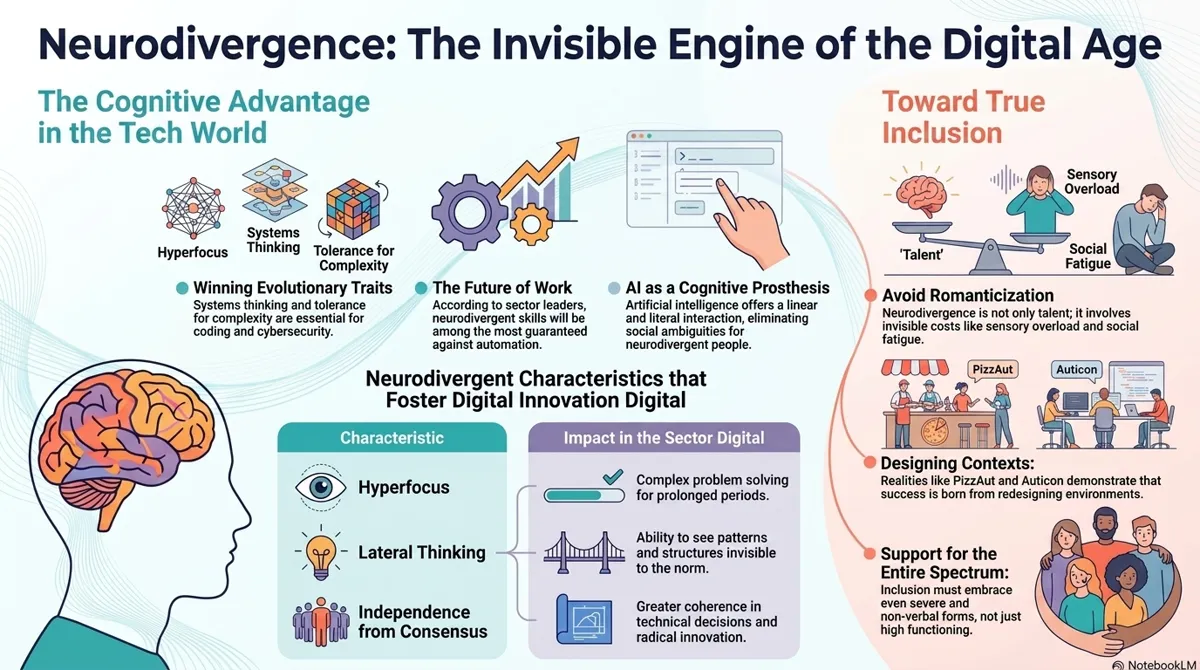
Luca Pani describes recurring characteristics in these minds: systemic thinking, the ability to handle complexity, absolute focus on a topic, relative indifference to group judgment. In traditional social life, these qualities can create friction, but in the digital world they often become an enormous advantage. And then there is the machine, which for many neurodivergent people is not a cold object but an almost reassuring presence. The machine does not imply, does not insinuate, does not pretend to be understood through the unsaid. It is literal. It is coherent. It has an explicit logic. And for those who struggle with social ambiguity, this can change everything. Matteo Flora points out clearly that AI, precisely because it uses a language without double meanings, can become an extraordinary cognitive prosthesis.
Beyond the Romanticised Narrative: Seeing Talent in a Different World
However, as we recognise the value of these differences, we must be careful not to fall into a very refined and widespread trap: romanticising neurodivergence only when it produces talent, innovation, or profit. The daily reality of those on the autism spectrum, or with ADHD, or other neuroatypical ways of functioning, is not only made of special abilities. It is also made of noises that become too loud, lights that tire, cluttered environments that drain energy, social relationships that require constant interpretation. Things that are trivial for many become an enormous invisible cost for others. Gianluca Nicoletti reminds us with lucidity, speaking of his son Tommy and all the forms of autism that do not end up in the more reassuring narratives. Autism is not just the genius of computer science or finance. There are also severe forms, non-verbal people, families living in continuous struggle, lifelong supports that cannot be delegated to chance or goodwill. If we lose this piece, the discourse empties out.
Designing for Inclusion, Not for Adaptation
Here enters a question that interests me greatly: can technology truly be an ally of the person, instead of asking the person to brutally adapt to the system? I think yes. But only if we change perspective. There are tools that go in this direction, precious because they do not promise miracles, but concrete facilitation. Applications designed to manage routines or read emotional states, like Tsunami, are born from a logic of support and not control. Experiences like Develop Players transform neuropsychological screening of children into something less threatening, almost more livable. And models like Auticon show a simple and powerful thing: diversity ceases to be a problem when the context is built to welcome it. PizzAut is an example that always strikes me, because there is no paternalistic idea of “inserting” someone into a pre-existing system. Instead, there is the choice to rethink the system starting from people. When we talk about inclusion, we often imagine it as an act of benevolence. But it doesn’t work like that. Authentic inclusion is not a concession. It is a design.
In an era when artificial intelligence frightens us because it seems to flatten everything, neurodivergent people remind us of an elementary truth: the value of a mind lies not in its similarity to the average, but in its uniqueness. The real question is not whether neurodivergence is a limitation or a resource. The real question is: what are we willing to do, as a society, to not turn diversity into loneliness? The measure of our progress will not only be in the quality of the algorithms we build, but in the ability to listen to those who experience the world in a less linear, more difficult, more sensitive, more intense way, and in the willingness to ask no one to erase themselves to be accepted. As poet Sandro Penna wrote: “Happy is he who is different being different, but woe to him who is different being ordinary.”
Frequently Asked Questions
For context: designing for neurodivergent minds connects with my arguments in the new cognitive architecture as a disabling environment and in reclaiming attention in digital life: inclusion is not adaptation, it is architecture.
What is neurodivergence?
Neurodivergence refers to variations in the human brain that affect how people think, learn, and interact with the world. It includes conditions like autism, ADHD, dyslexia, and other neuroatypical ways of functioning. It is not a disorder in itself but a natural difference in cognitive wiring.
Why is artificial intelligence considered useful for neurodivergent people?
AI operates with literal, unambiguous logic, which can be reassuring for those who struggle with social ambiguity, double meanings, or unspoken cues. It can act as a cognitive prosthesis, helping to structure routines, interpret emotions, or reduce the mental load of everyday interactions.
What is the risk of romanticising neurodivergence?
The risk lies in valuing neurodivergent traits only when they produce exceptional talent, innovation, or profit. This narrative ignores the daily struggles,sensory overload, social exhaustion, institutional barriers,that many neurodivergent people face, especially those with severe or non-verbal forms of autism.
How can technology be designed for genuine inclusion?
Genuine inclusion means redesigning systems around the needs of the person, not forcing the person to adapt to the system. Examples include apps like Tsunami for routine management, Develop Players for child-friendly screening, and companies like Auticon or PizzAut that build workplaces and services from a neurodivergent perspective.
Keep exploring
Deep dives, daily AI commentary in multiple languages, and my curated showcase of lifelong learning.