The Three Titans' Alliance: Power Play or Ethical AI?
Sam Altman, Dario Amodei and Elon Musk now speak with one voice about slowing AI down. Is the three Titans' alliance a sincere ethical stance or a power play to lock in their market position? The answer decides who builds the next generation of artificial intelligence.
The rhetorical shift is as elegant as it is effective. By championing a narrative of existential fear and prudence, these three figures transform themselves from fierce competitors into collective stewards of the public good. Yet in practice, their alliance works to define the very terms of participation in the AI race. The message is subtle but clear: they decide who gets to build the future. The result is a branding strategy that elevates caution into a competitive advantage, one that masks utilitarian ends behind the language of ethics.
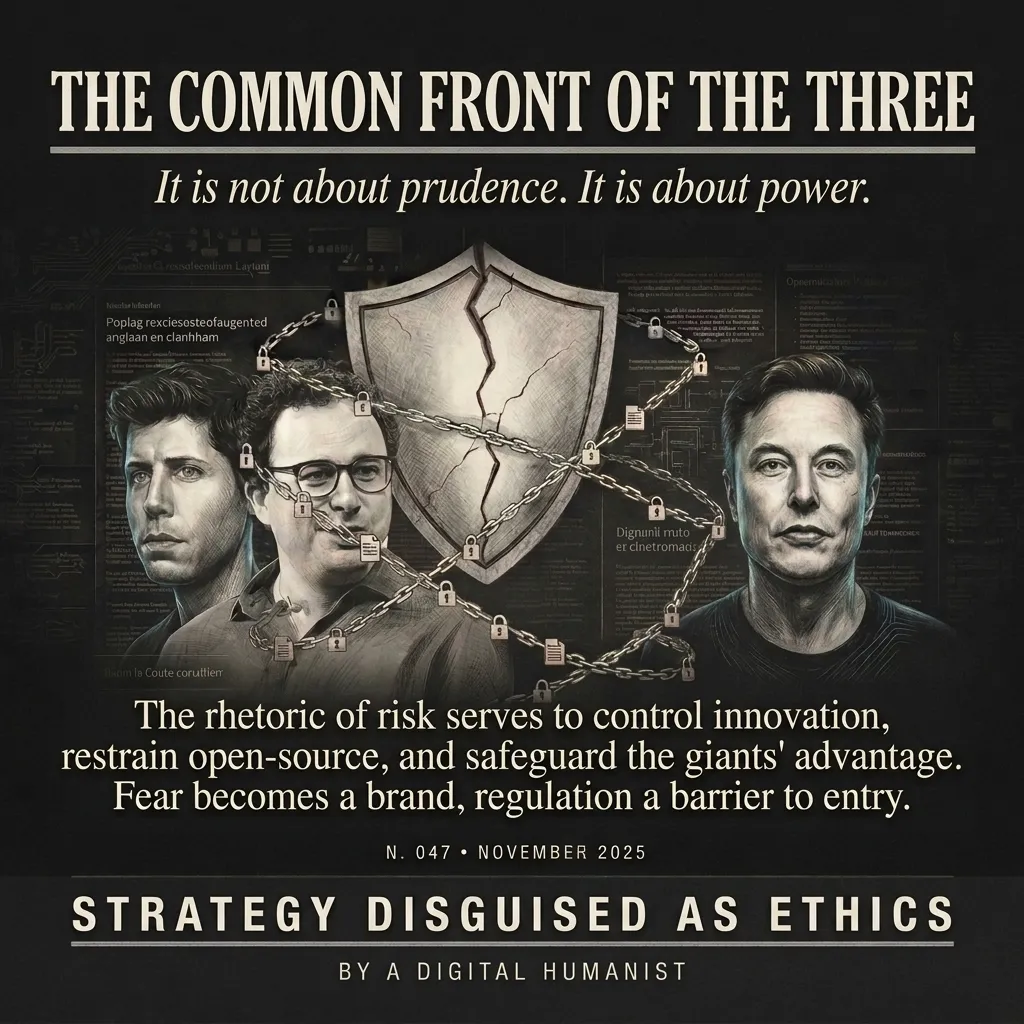
The Titans' Alliance: Risk Rhetoric as a Market Tool
Fear of catastrophic AI outcomes has become a powerful instrument for justifying regulatory frameworks that, by design or effect, erect high barriers for new startups and independent developers, the same concentration of power I described in The Power That Speaks Softly: Peter Thiel's Secret Club. When the loudest voices calling for restraint are also the ones with the most to lose from disruptive competition, the ethical appeal becomes inseparable from a calculated market maneuver. Altman, Amodei, and Musk each benefit from a world where the pace of innovation is moderated by rules they helped shape, and where the cost of compliance suffocates the very open-source movement they occasionally praise.
In this context, the image of a responsible leader becomes what the French call a passe-partout, a master key to trust, access and influence. In an era where institutional credibility is scarce, the appearance of moral foresight is a currency more valuable than any technical lead. The trio has effectively turned alarm into a brand, cultivating an aura of wisdom that transforms prudence into a moat around their own enterprises.
Three Voices, One Narrative: Monopoly and the Open-Source Debate
To understand the full implications of this alliance, one must read it not merely as a technological debate but as a significant cultural signal. The way AI is perceived and discussed has real consequences for who participates in its development. By monopolizing the narrative, as I argued in The Illusion of Free AI and the Coming Digital Caste System, these few actors maintain control over the direction of the entire field. The rhetoric of ethics serves to mask utilitarian ends; it is not an alert but a branding strategy.
If we do not seriously confront the ethical and practical implications of this narrative dominance, we risk being trapped in a discourse shaped by a small elite. Authentic innovation requires transparency, genuine support for open-source platforms, and inclusive governance that involves a variety of stakeholders in defining the rules. The future of AI must not be dictated by a narrative monopoly, it should be the result of a genuine dialogue among all actors. Only by reclaiming narrative power can we ensure that technological progress serves everyone, not just a select few.
Frequently Asked Questions
Why would competitors like Sam Altman, Dario Amodei, and Elon Musk agree on slowing AI development?
While they present this as an ethical precaution against existential risks, the agreement also serves to limit competition and define who sets the rules. By advocating for caution, they position themselves as trusted guardians and create regulatory barriers that are harder for smaller players and open-source projects to overcome.
How does the narrative of AI risk function as a branding strategy?
Fear of AI catastrophes becomes a tool to justify regulations that in practice benefit established players. The image of a responsible leader builds credibility and trust, turning caution into a competitive advantage disguised as common sense. This ethical rhetoric masks what is also a market maneuver.
What is needed for a more inclusive direction in AI development?
Authentic innovation requires transparency, support for open-source platforms, and inclusive governance that involves a variety of stakeholders. The current narrative monopoly must be broken so that the future of AI emerges from genuine dialogue rather than being dictated by a small elite.
Keep exploring
Deep dives, daily AI commentary in multiple languages, and my curated showcase of lifelong learning.